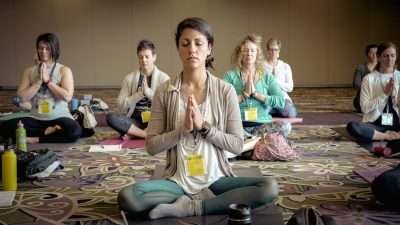
Yoga is a benefit for all age groups!
This week I’m again happy to introduce you to another great blogger/writer named Jennifer Koshak. I first started following Jennifer’s blog Unfold and Begin several years ago because so many of her topics are about creativity, starting over, and trying new things–how SMART is that? Jennifer lives in Connecticut where she frequently teaches workshops on creating with Vision Boards. With a strong intention to help others make the most of mid-life and beyond, Jennifer writes with humor, insight and inspiration. A woman with many talents, Jennifer began teaching yoga in her 40s and taught seniors the many benefits of yoga for over ten years. Whether you’ve ever been to a yoga class, or consider yourself a senior or not, her insights are a good introduction to why yoga can be beneficial for us all.
On my blog Unfold & Begin I usually write about creativity, Vision Boards and writing. But because I used to be a yoga teacher, I’ve also written about teaching yoga to seniors. However when I did, it was more about how much I enjoyed teaching the classes—not the actual benefits. So today I am sharing the many values of yoga for seniors.
The good news is that there are many benefits that seniors can enjoy while practicing yoga. And there are numerous studies to support these benefits which include the obvious physical benefits (flexibility, balance, etc.,) along with mental (stress and anxiety,) and emotional (depression) improvements.
Yoga Benefits
Physical
1 Balance and Flexibility are big concerns for seniors. Stumbles and falls can easily cause problems from minor strains and tears to more serious issues like broken bones. The less confident a person feels in their balance has a direct impact on how much they get out to do things. And someone who is looking to gain improvements in balance doesn’t need to spend a lot of time in hour-long classes. Practicing 15 minutes a day is enough to enhance both balance and flexibility.
When I was teaching yoga to seniors in a retirement community I had one student who came to class each day using a cane. By the second month of twice-a-week hour-long classes, she was still carrying the cane with her but not really using it. She said she felt her balance had improved but didn’t trust it and wanted to make sure her cane was there to “catch her” if she experienced any problems. In her third month of classes, she just got up from savasana and walked out of the room. She forgot that she even “needed” the cane and never brought it with her after that.
Another of my senior students found her enhanced flexibility helped her when she was sitting on a short stool cleaning out shoes from her closet. When she was done, she couldn’t stand up again and didn’t know what to do. But then she remembered that she could stand up from a down dog position and she got onto her hands and knees, lifted her hips up into down dog and then walked her feet closer to her hands until she was able to stand up. It was something that we’d been working on in class for that very reason.
2 Reduce high blood pressure. Studies show that yoga, which not only focuses on postures but also includes breathing exercises and meditation, can significantly reduce high blood pressure. The studies speculate that controlled breathing helps to reduce nervous system activity, which in turn reduces blood pressure levels. I found this to be true for myself. While I wasn’t able to completely eliminate blood pressure medicine, my dosage has significantly reduced.
3 Improved Quality of Sleep. The benefits of improved sleep are important since lack of sleep can have a negative impact on numerous health-related issues including depression, loss of cognitive abilities, obesity, increased inflammation in the body and increased risk of heart attack.
A 2005 study found that elderly patients who took yoga classes were able to fall asleep faster, sleep longer, and feel more rested the next morning. Studies found that post-menopausal women had improved quality of sleep with a regular yoga practice. The benefits include better sleep as well as improved quality of life.
4 Reduces inflammation and arthritis pain. Yes. Yoga does help. Studies show that regular yoga practice can reduce inflammation, reduce joint pain, and improve joint flexibility. Another study showed that a 90-minute modified yoga class, taken just once a week, significantly reduced pain and improved movement in patients with knee osteoarthritis. Yoga can add muscle strength while building balance in patients with arthritis. And for people with Rheumatoid Arthritis, there was a decrease in blood markers associated with inflammation.
Mental Health
a) Anxiety. Yoga has already been shown to reduce anxiety. This includes symptoms of PTSD. Yoga, in the form of Yoga Nidra, a yogic sleep guided meditation, allows the practitioners to benefit from deep relaxation. But PTSD is not just about soldiers. Many people who’ve been through traumatic experiences can suffer PTSD and Yoga Nidra helps. It calms the sympathetic nervous system that activates the fight or flight response. So helpful in a battlefield, but not so helpful when at home trying to rejoin your life.
b) Stress. Stress can go hand in hand with anxiety or stand on its own. Chronic stress is linked to the six main causes of death including heart disease, cancer, lung ailments, and even suicide. Mindfulness exercises including meditation, breathing, and yoga all have been proven to reduce stress. Yoga reduces the heart rate, lowers blood pressure and improves respiration. All of which help to reduce stress on the body.
Emotional
Depression. People with depression have reduced serotonin. One study showed that yoga increases serotonin production which plays a major role in happiness. Another study found that twice a week yoga sessions for eight weeks reduced depression scores. In addition, the study participants rated the actual yoga practice a 9.4 out of 10 meaning they liked participating in the yoga class.
Yoga Classes for Seniors
First, as with any exercise program, seniors should consult a doctor before starting. It’s also important to make yoga instructors aware of any physical disabilities or constraints that might require modifications in the poses. In my experience, I have found that seniors are more willing than 20-somethings to discuss their physical ailments and to let you know when a pose isn’t working for them. In order to have a good experience, first-time senior yogis should look for the following.
- One on One instruction.If you are new to yoga, it’s sometimes beneficial to start one-on-one with an instructor in order to learn the correct poses. This especially applies in order to learn the correct pose for your body. There is no shame in having to modify a pose or use props, straps, and blocks in order to get comfortable in a pose. Look for someone who teaches Iyengar yoga or gentle yoga. Even though you might be using props or doing a modified version of a pose, you are still gaining the benefits of the pose.
- Chair Yoga is another modified version of yoga. Can’t get down on your hands and knees? That’s ok because a chair can assist you in completing poses that might otherwise be done on the floor. When I taught at the retirement community, I used chairs to assist with some poses, but we also did poses on the floor. Usually, these were seated poses and not ones that required kneeling. Chair yoga is generally taught in a small class environment.
- Gentle Yoga. This type of yoga is also usually taught in a small class environment. If this is a beginner senior class, look for one that has less than 10-12 students. It’s the instructor’s role to ensure everyone is moving into poses safely and with a beginner senior class, too many people may need attention. Gentle yoga classes focus on alignment and include both standing and seated poses. These classes are a great starting point for people with movement limitations.
- Restorative Yoga. This is another great starting point for a senior who is new to yoga. This is best for someone who is comfortable getting down and up from the floor. Restorative poses are designed to invoke relaxation. Each pose uses a series of props (bolsters, blocks, and straps) that will allow you to relax into a pose. The props hold you in the pose instead of you and your muscles working hard to keep you in a pose.
The key to any great yoga practice whether for beginner or expert yogis is to start where you are and stay on your mat. You may have heard that phrase before, but in yoga, it is crucial for protecting yourself from injury. Don’t look at the other students, especially expert students, and try to copy what they are doing. Instead, listen to your body and only go as far as your body is telling you that it’s able to go.
Have you tried yoga yet? If you want to know more about how yoga fits into a Senior’s life, I highly recommend reading the book Yoga in the Morning, Martini at Night.
About: Jennifer Koshak is a fifty-something
mid-life blogger who writes about creative inspiration, starting over in midlife, trying new things, and vision boards on her blog Unfold and Begin. She chose the title Unfold and Begin as a way as a way to remind us all that we need to open up, share ourselves, try new things and embrace life with a bit of creativity and a lot of curiosity.
 mid-life blogger who writes about creative inspiration, starting over in midlife, trying new things, and vision boards on her blog



Hi Girls,
Have been using yoga to stretch a very tender glute and leg and it is helping. I am less stiff, more limber, and experiencing less discomfort. My Prince C. is doing it with me, too, before we workout but we have neither one had formal yoga training. Thinking once it cools off and fall arrives, we need to take a couple of classes to learn how to do the moves we are doing now correctly. Great info!
Hi Leslie! It sounds like you’ve been doing a good workout but I think you’ll be pleased to take some classes and learn some of the postures a bit better. It is really helpful! ~Kathy
Hi Jennifer and Kathy,
I’ve often thought about getting involved in yoga…I know about it’s benefits, particularly as we age, but really at any stage in life.
It’s a matter of access and making it a priority.
Thank you for putting this on my radar again.
Hi Jennifer, I love your post! I began yoga about five years ago and my only regret is I wish I would have started doing some form of yoga sooner in my life. As we get older I have heard the concept of “functional fitness.” I can’t imagine how rewarding it must be for you, the teacher, when you see students walk without the help of a cane such as in your story.
I am nodding yes, to everyone of the points you make. Thank you for reminding me of the Yoga Nidra classes. My studio is primarily Bikram Hot Yoga, although two nights a week they offer the Yoga Nidra classes. I would like to add these to my week.
Thank you for an informative post and a great read!
Hi Jennifer and everyone! Thank you so much Jennifer for filling in while I was gone. I figured that my SMART readers would appreciate your perspective. Yoga has played an important part in my life and I encourage everyone to at least give it a try. And might I recommend that if one doesn’t “fit” you, try another teacher. I’ve had to get through several “okay” teachers to find one that fits me perfectly! And thanks to everyone who commented and made Jennifer feel welcome here on SMART Living 365. ~Kathy
Private sessions are a great way to learn poses safely. And doing it together is helpful. My husband and I sometimes take yoga together.
I keep “meaning” to begin taking yoga. I’m not sure what’s stopping me beyond simple inertia. I think both my husband and I could benefit greatly. Maybe it’s time to just do it. I like the idea of having a few private sessions just to learn the poses and how to do them correctly.
Could you provide links to the studies you mention, the citations or something that will help to find those studies?
All the links for the studies that I mentioned can be found in my original post. There are too many to list here. https://www.unfoldandbegin.com/what-are-the-benefits-of-yoga-for-seniors/
Thank you!
I gave it my best, but the class was wrong for me. It was said to be “Gentle yoga” for anyone with limitations. I’m a still old 65; I was a stiff little kid. Yoga never feels “gentle” to me if you have to sit on the floor with your legs crossed. Also, while I could DO downward dog, my head felt like it was going to explode and my wrists hurt afterward for a week. Luckily, I found a video of older people doing chair yoga. I think it’ll be a good thing even if it’s not like the picture above. And if I get half the above bennies, wow.
You should find an Iyengar teacher to do one on one yoga with you. There are many adjustments that can be made, especially for the wrists. Have you tried doing a modified downward dog using the chair? Not as much weight goes into your wrists and your head doesn’t go as low, but you can still get the full-body stretch.
Thanks for that idea, Jennifer. I am motivated to find a fit, because I’m eager to win the benefits!
Hi Jennifer & Kathy- I have been reading Kathy’s blog for a while, and find her posts thought-provoking, but am generally not a responder. However I must respond to this. I highly recommend chair yoga. I am 67, with 2 major back surgeries. One in my late 20s for a disc and a recent one for a spinal cord tumor. I can’t get on the floor, but can do standing and seated poses. I take a 1 hour weekly class then do about 20-25 minutes at home 3x a week after I lift free weights. (I wrote down the class poses after a year for independent work.) My chiropractic visits have gone from every 1-3 weeks to every 4-6 weeks! The yoga has changed my life. (I also have been a swimmer my whole life, and swim 1/2 mile-3/4 mile twice a week and walk a lot but I am certainly no athlete.) so please everybody give it a try!
Thank you for responding and telling us about your journey with yoga. Chair yoga is wonderful when you can’t get down on your hands and knees and I’m glad to hear that it helped you so much!
Hi Caroleso! Thank you so much for sharing your personal experience with all of us. I agree that finding the appropriate fit is really important to continuing the practice like you say. And something else—finding the right teacher is also extremely important. I guess you could say that we should all “rightsize” our yoga practice. And definitely “rightsize” our exercise routines. Good for you for staying as flexible as you can AND for being able to limit your chiropractor visits. ~Kathy
Jennifer, it is great to see you on Kathy’s blog! I love the yoga classes at my gym but only go once a week. I’m recovering from foot surgery so I am anxious to get back to the yoga class shortly. You are so right about improving our balance, flexibility, and strength as we age! Great information!
Thanks for stopping by, Terri. I saw your post of you running around on your “leg scooter.” I hope you’re recovering well!
Hi Jennifer and Kathy, I have never practiced Yoga, but I do know a few poses and use them for balance and strength (not with any regularity), but they do seem to help. Sadly, the only thing that keeps me from making it a habit is the absence of desire. Maybe your post will inspire me to reconsider the benefits and give it a go. Thanks for the nudge.
Nudge, nudge. I’m glad you’re getting inspired by the benefits of yoga. All it takes is one class.
Hi Suzanne! Thank you for sharing your own personal experience with yoga. One thing that I think helps me is to find a friend who will either drag you to class (or you drag them!) When you through a bit of accountability AND friendship into the mix it is even more rewarding. Good luck!!! ~Kathy
Jennifer, Nice to see you over here on Kathy’s blog! I started yoga in my first year of retirement and really enjoy it. I have found many of the benefits you mentioned, although I hadn’t realized potentials of improved sleep or impact on arthritis. I’ve found I like more of the flow/power classes at the moment. I’ve also found I need a class, and not just an on-line connection. Finding a teacher that you ‘connect with’ is also important. Their tone, speed, class awareness…. all that makes a difference to me in really enjoying and wanting to return to that class. I’m about to start a search for a new class…. the place I’ve been going is closing. So I guess it’ll be on-line for awhile for me.
So glad you stopped by, Pat. I’m glad that you took up yoga after retirement. It helps so much with flexibility and balance, which is so important as we age. If the place you go to is closing, find out if your favorite teacher is going someplace else. Many teachers have people who follow them from one studio to the next.
Hi, Jennifer – It’s wonderful to see you here on Kathy’s site. I first began yoga when I retired four years ago, beginning with gentle classes and moving on from there. I agree with ALL of the benefits that you have listed. Since there are so many varied classes out there, I highly encourage any interested to go ahead and give it a try (or a retry for those who haven’t done yoga in awhile). You never know, it could lead to a great passion….it did for me!
Glad you are enjoying the benefits of yoga, Donna. Once people start, they find they can move on from their beginner classes and try different things. I’m glad to hear that’s exactly what you’re doing!
Thanks for this article. Most timely and the nudge I need to get back into yoga!
Deb
Here’s another nudge!
So many benefits, so many good outcomes!
So true! Thanks for stopping by!