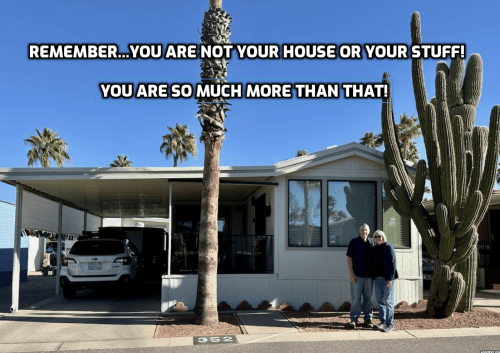
 A couple of weeks ago Thom and I drove to our house in Southern California that we had called “home” for sixteen years. Even though we called that property home, we actually lived in Tucson, AZ for the last three winters while renting that “former home” temporarily. Then after that we only ended up staying there for a few days on and off the rest of the year. However, after straddling both homes for three years, we decided it was time to make the decision to pick one over the other. And in spite of the fact that the one in So Cal was over twice as big (plus a two-car garage) as the one in Tucson, we chose to permanently make our tiny home in Tucson our residence for the foreseeable future.
 For my entire life I have avoided the very idea of suffering. It’s not that I don’t feel sympathy for others when I witness others going through challenging times, but as for me—nope! With the arrogance of youth, I remained convinced that even when things looked disastrous in my life, I could always work them out. Like Pollyanna, I didn’t deny bad things happen to good people, I just felt certain that with the right approach anything could be overcome. Then when I came upon the New Thought philosophy, it gave me the tools (or at least the narrative) about how to do just that. But you know what? I’m much older now and I can’t help but look around and notice that people are suffering through no apparent fault of their own. Sometimes, no matter what you do, stuff happens. And yes, if I’m honest, there have been times when I have suffered physically and mentally. Maybe that’s why when I came across Richard Rohr’s new book, The Tears of Things—Prophetic Wisdom for an Age of Outrage I knew there was something there for me to consider.

 How many times in the last few months (or years) have you heard someone make a statement that was so bizarre and outrageous that you could barely believe anyone could think that true? I have—more than once. It’s tempting to just roll my eyes and try to run in the opposite direction. That, or silently accuse them of (among other harsher judgements) not being able to think critically. But unfortunately, those actions don’t seem to be isolated. In today’s world it seems that such declarations and behaviors are everywhere—in the media, online and out of the mouths of people we meet at the grocery store. We can’t run from everybody who lies and/or makes up wacky assertions. Instead, maybe we ought to learn, and to teach each other, how to critically ignore that input. Or, as William James, the author of The Principles of Psychology wrote, “The art of being wise is knowing what to overlook.”
 I’m the first to confess that I like my conveniences. I love having both a laptop and a desktop computer so I can write or research anywhere I want. I can’t imagine living without my hearing aids being able to connect to my iPhone so I can take calls or listen to music anytime I want (not to mention hear well!). Speaking of my iPhone, knowing the temperature today and for the next 10 days anywhere in the world seems important, doesn’t it? Or what about Google Maps telling me where I am at any given point day or night? I don’t know about you, but without those comforts (and I didn’t even mention air-conditioning, televisions, a washer/dryer and a thousand other household items) my lifestyle would seem antiquated. Clearly all those things and so much more make my life comfortable. But are they necessary? And is it possible that taken all together there are unforeseen costs that are making me lazy?
 How’s your focus these days? Have you started to do something, got distracted and then forgotten what you were even doing? I have. For the last year or two I have increasingly noticed how much more difficult to do so many things I used to do easily like write a blog post. But it isn’t just with writing. I’ve also noticed how it’s become more challenging to find the time to sit and read a book, focus on certain tasks, or consistently do other things that used to be part of my days. Meanwhile, time seems to be speeding by and I’m feeling busier than ever. Besides being easily distracted, my memory isn’t what it used to be. To explain it all, I assumed it was because I was getting older. Nope. I’ve since learned that this inability to focus and pay attention is a result of bigger forces at work. Of course, as the saying goes, to cure something, we must first know why it’s happening.
 Years ago, Thom and I scaled back our living space and rightsized. That conscious choice was to sell our larger home and buy one nearly half the size. Our decision not only saved us a significant amount of money—more importantly, it gave us the peace of mind and freedom to live in a way far more aligned with what matters most to us. So even though we had fewer “rooms” in our house, in the end our new home offered us many more opportunities to create the lifestyle that we wanted. Taking things a step further, sometimes a home and the rooms inside offer a far more important analogy than simply a place where we dwell.
 It is said if you look long enough you will find what you are looking for—or it will find you. So, after a couple of months of not feeling inspired or excited to write much, I finally stumbled upon an idea that just won’t let go. Of course, that idea will take a while to completely unfold, but ever since I first heard it I felt captured and inspired by a new way of looking at things—a new way of looking at life. That idea is an optimistic protopia. What is protopia? It is the middle way between a dystopia or a utopia. It asks, will our futures look like a dystopian disaster where the planet and humans are fighting tooth and nail to survive? (Think of the movies Terminator or Mad Max.) Or will it look like a utopian dream where everything is perfect, all people are “perfect”, and nothing ever changes? Until recently no one really talked about a third alternative. A middle way. And that future is protopian. I’m guessing most people never even heard of it just like me.
  Did you ever play house as a kid? I did. And while once in a while my play house would contain a family with kids, most of the time my play revolved around adventure and the experience of living somewhere new. Then like most of us, I assumed I gave up playing house when I became a teenager. But this last week I realized that in many ways I still play house on a regular basis. In fact, every time Thom and I rent a vacation rental we are “playing house” in a similar way. Taking that a step further, this last week Thom and I bought a Park Model in Tucson and it hit me—this is just another way to play house! What about you? Did you play it as a kid? And are you playing a variation even today?