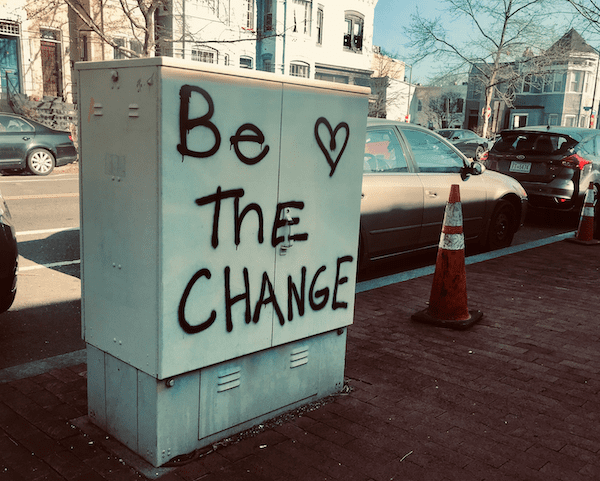
 For my entire life I have avoided the very idea of suffering. It’s not that I don’t feel sympathy for others when I witness others going through challenging times, but as for me—nope! With the arrogance of youth, I remained convinced that even when things looked disastrous in my life, I could always work them out. Like Pollyanna, I didn’t deny bad things happen to good people, I just felt certain that with the right approach anything could be overcome. Then when I came upon the New Thought philosophy, it gave me the tools (or at least the narrative) about how to do just that. But you know what? I’m much older now and I can’t help but look around and notice that people are suffering through no apparent fault of their own. Sometimes, no matter what you do, stuff happens. And yes, if I’m honest, there have been times when I have suffered physically and mentally. Maybe that’s why when I came across Richard Rohr’s new book, The Tears of Things—Prophetic Wisdom for an Age of Outrage I knew there was something there for me to consider.
Even though Richard Rohr is a priest in the Franciscan tradition it wasn’t his theology that attracted me to this book, but rather his wisdom. It probably helped that I heard him on two different podcasts before picking up the book. But rather than repel me, his message intrigued me. His words and this book give me a new perspective on suffering by offering an alternative view of the state of the world that we live in. Better yet, he offers the metaphor of tears as a passage forward into hope.
He starts with the obvious. Nearly everywhere we look in the world we see what appears as anger, rage and even hate. No matter what side of the divide we stand on, we see ourselves as the righteous and the other side as the problem. Again, no matter what side we are certain and justified in our anger and rage—and the cycle goes round and around. We convince ourselves that if the “other” just did what we think is right, then everything would be perfect or at least go back to “the good old days.” But as Rohr says, as long as we hold on to our anger and righteousness, we are only perpetuating the problem.
Of course, Rohr isn’t afraid to call evil, evil. He is a priest after all. But while he uses the Bible frequently, he is also a big fan of Carl Jung. One of his major premises is that the shadow side of our culture (including within religion) is now rearing its ugly head in a big way. So, the horror that some of us are witnessing (not to mention experiencing) has finally come to the forefront of our culture. The systems that created the world that many of us live in, step on the backs of those less fortunate. We see the world from a perspective of winners and losers or those that reap rewards while the other side deserves punishment (heaven or hell)! And guess which side we want to be on? By the same token, the more we individually make fame, success, power and money the “God” that is worshiped in our culture, the more we will rationalize away those who don’t do the same.
For example, the shame, frustration and fear we project onto the homeless is likely a personal shadow that many reject in ourselves. Immigration the same. Even greed. Anything we make wrong, or bad, or avoid at all costs is that shadow within that which we deny or (often unconsciously) deserves punishment. As Rohr says, “…we like our illusions, we like having enemies, and we are quite accustomed to our wars and prejudices…They make us feel morally superior, even heroic…thus dividing the world into absolute good and absolute evil, and leaving us, of course, on the side of absolute good.” So, we need to keep in mind that if we don’t transform the underlying pain and egoic shadow (both personally and culturally), we will transmit it in another form. There is obviously a lot of evidence of that happening all around us.
But what do we do with our anger? Rohr contends that “most anger comes, first from an unacknowledged place of deep sadness.” This “way of tears” requires a deep vulnerability that is opposed to our normal (western) way of seeking control through willpower, commandment, force, retribution or violence. As Rohr says, “it is hard to be on the attack when you are weeping.” He believes that grief, sadness and yes, our tears, lead us to understanding life in a non-egocentric win-lose way and can lead to greater empathy and connection.
At the same time, he believes that “Anger can be deserved and even virtuous, particularly when it motivates us to begin seeking necessary change.” But we can’t stay in our anger. If we do, we just extend the hurt in new directions and often upon ourselves. By accepting that behind our tears is our own pain and sadness, we transmute the anger into love. Not a mushy, no action love, but an all-encompassing love that moves toward what needs to change with as much compassion, awareness and maturity as possible.
A favorite saying of my husband Thom is that to break through—you must first break down. Rohr has his own way of saying something similar. He sees progress (and maturity) as going though first order, then what seems to be disorder, and finally reaching some kind of reorder. Rohr says, “Without this growth process, most of us believe our first presented order is all there is…. What we learn early in life, with the mind of a four—to six-year-old, is just to get us started. We need to grow up and realize that life is not a game of either—or. No issue is just black vs. white. Instead let’s move toward a “both—and perspective”. The pathway there is to first admit to our sadness and grief, and then transmute it.
So where does this leave me with my aversion to suffering? I have slowly come to admit that while I would prefer to avoid it all together, the longer I live the more likely I will continue to see it unfold around me. Things change, people die, certainty does not exist. It’s time to admit that suffering isn’t the issue, my fear of suffering is what makes me want to run from it or project it onto others. And while I still believe that I can change my mind (my perspective) about the circumstances happening in myself and around the world, I don’t have to deny the situation or project my anger and fear onto others to avoid it. Instead, while I can work to make changes that move toward more equality and compassion for others, I won’t do it from a righteous or better-than-thou perspective. And when tears are necessary, I let them fall.
Another thing that Rohr is very clear about is the awareness that the problems we face in the world are not held by one or two particular people. The ills of the world will not be solved by throwing the “evil doer” out and putting in our righteous choices. Instead, it is the outdated systems and a nihilistic culture that is allowing certain people to do what they do that causes the growing problem. Get rid of one, and another person will pop up to take their place. And let’s not feel that one side over the other is the ultimate solution in a win-lose scenario. If the culture and systems that are creating the kind of division and turmoil we are seeing in our country are allowed to rule us, then the problems will only fester and grow. Plus, it is naïve to believe that you and I are individually innocent in our own participation in a culture that glorifies success, money, power, fame and force. The only way circumstances will change is when we do.
As others have said, we can’t fight hate with hate. Running from or denying pain or suffering only allows it to build in our unconscious in unhealthy ways. Perhaps, the SMART way is to allow ourselves to feel the sadness for the troubles of the world and accept where we participate. Only then will we be able to accept the compassion, love and necessity for connecting on all sides. I’m not there yet but I’m closer than I was before.




I just discovered Richard Rhor’s work a few months ago. I have been getting his daily meditation via email, and it typically has several nuggets of wisdom tucked in it. I appreciate your synopsis of his book, as I have heard it is a challenging read.
Hi Marian! How interesting! I am curious what you might have heard is challenging about it? His writing is quite easy to read so it must be something with his ideas? As with most books (mine included!), a reader doesn’t have to believe everything the author presents. But I still found enough there that made me think and examine how I viewed the world and other people as well as myself. I particularly like his thoughts on how the shadow in us all is out-picturing in the world. If you do read it, please pop back in and let me know your thoughts. (or better yet write a blog post about it yourself!!!) Thanks for stopping by. ~Kathy
That sounds like an interesting book. I’m not sure that what I am feeling is anger exactly, but maybe a bit of righteousness. I’m still convinced that if the ‘other’ just did what I think is right, then everything would be, if not perfect, than at least better. ?
Hi Janis! I was really only interested myself after listening to a couple of podcasts first. Plus, I had read in many places how much of the disillusionment in our country is coming from young people who are not just angry, they are experiencing rage. Rohr addresses that in his own way and how difficult it is for most of us (yes a lot of men) to admit that things in their life are not turning out the way they hoped–and that creates a deep sadness. When you experience a lot of people who are angry and disappointed, (stuffing their sadness) that is the stuff of revolution. I found it very helpful to see what is happening in our country from a different perspective than my usual “bubble” and it has really helped me. Not sure it would help others but I thought it was worth exploring. Thanks for jumping in here with your thoughts. ~Kathy
Richard Rohr has certainly become one of mentors, even though we’ve never met, through his books. (Your intro sounds just like an Enneagram 7, which is another concept I’ve learned more about from Rohr.) Our world is both wonderful and horrible, full of joy and full of sadness all at the same time – each one of us are inherently good and have capacity for evil – and all that seems to be a paradox that we learn to recognize and “hold” the more we experience and mature.
Hi Michelle! Yes, you’ve caught me by recognizing my Enneagram 7! 🙂 I guess that is why I was willing to read this book in the first place because I appreciate all the work he’s done on the Enneagram–even though his writing is normally more religious than I prefer. But as you said, he is all about the wholeness of the world…the joys and the sorrows..all at the same time. And writes a lot about the paradox of holding it all. If you get a chance I think you might enjoy the book. And I listened to a podcast where he talks about each chapter…The name of the podcast is “Everything Belongs.” ~Kathy
Brilliant summary – thanks Kathy. This is really meaningful!
Thanks Deb! Talk to you soon! ~Kathy
Good things to think about and own our part of what we might do. We are not “individually innocent in our own participation in a culture that glorifies success, money, power, fame and force…we can’t fight hate with hate.”
It is not we vs them. Lets spread calm and more calm, doing what we can today!
Hi Gary! It’s not always easy to take a look at our own “shadow” and recognize how we participate in a culture that has created some of the situations now facing our country and the world. But if we want things to change it is necessary–otherwise it just keeps happening again and again. I’ve always appreciated the work of Carl Jung and really appreciated how Richard Rohr tied into in terms of culture and religion. Thanks for checking in with this! ~Kathy
Wow, once again we are in sync. I just started reading this book after two people mentioned it to me last week. I’ve admired his wisdom in several other books, and I look forward to this one. It seems remarkably timely, and the topic is one that seems to come up so frequently in conversation. Thanks for sharing your own take on it.
Hi Galen! I was in the process of getting this blog post up and posted when you commented on the last one. It’s great of you to connect. I do subscribe to your blog too and always enjoy the posts I take the time to read. Of course when I say I “enjoy” them, what I really mean is that they make me pause and think and very often bring a sense of peace. If I can do that with any post these days I figure they are worth the time and trouble. And I would VERY MUCH like to hear your thoughts on the book when you finish it! I hope all is well in your world. ~Kathy
I’m just starting this book, but it already reminds me of a book by Pema Chodron titled No Time to Lose. While Rohr focuses on the Hebrew prophets, Chodron takes her inspiration from a Buddhist text written by 8th century sage Shantideva. I think I might go back and reread that as I’m reading Rohr’s book. Between the two of them I should be saturated with inspiration and wisdom!
Hi again Galen! I’ve not read that book by Pema Chodron…thanks for the recommendation. I’ll have to take a look at it. After all I wouldn’t mind being “saturated with inspiration and wisdom” myself!!! ~Kathy