
Last week Thom and I drove back to our former home in La Quinta. We were able to rent it out seasonally for a spell but hadn’t been back to check on it since. Yes, the house is over twice as large as our tiny-house park model in Arizona. So, it feels rather spacious. Not big, but plenty of room. It is also very comfortable and familiar. We lived here for 14 years before our “experiment” in Tucson and made the house just right for us. That is until we began living in our community in Tucson. Now, after being back for only a few days something has become pretty clear. For us that means that our future and our happiness exist in the community we now have, rather than any particular house.
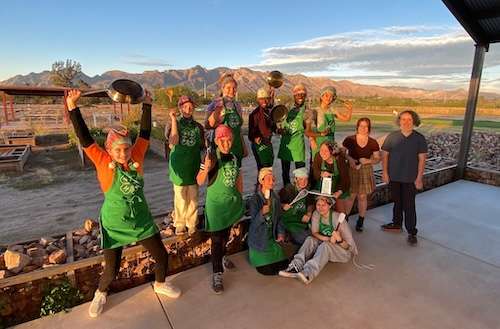 Every now and then, if we are lucky, we encounter a person or an organization that inspires us and gives us hope. Such is the case when Thom and I discovered Tucson Village Farms here in Tucson a year ago. Started as a dream in 2009 by two women, Leza Carter and Elizabeth Sparks, the goal was to build an urban farm where kids could be out in nature and see for themselves where food comes from other than grocery stores. From an initial dream that began with a one-acre plot of raw dirt, these women created an amazing facility that now, in 2024 alone, reached 11,000 youth and 8,000 adults through 491 year-round programs. One of their mottos is, “Changing the world one carrot at a time.”
 One of the advantages of being a writer for many years is that you have decades of writing to look back on as your age creeps upwards. I have been writing for over 40 years now and putting out articles on this blog for nearly 15. Through the years I have shared hundreds of ideas and curiosities with anyone who wanted to read along. Some of those thoughts I even put into books. At the same time I have been journalling for at least 30 years now so if anyone wanted to blackmail me, there is all the evidence they would need to judge me for my thoughts and actions. Fortunately, what’s most interesting at least to me, is that I can see how I have gradually grown and evolved through the years. So here are the top ten bits of wisdom I think I’ve gained the most.
  A few days ago as I was beginning my morning walk, my mind began churning through all the things I needed and wanted to get done that day. At the same time, I also remembered what I had neglected getting around to doing the day before—not to mention the week before. Then I knew it my thoughts began spiraling down that rabbit hole that many of us know too well. So, to distract myself, I grabbed my iPhone and started searching for a podcast to listen to as I walked One popped up on my screen titled something like, “Slow down and go with the flow in troubling times.” Just a few words into the podcast the author being interviewed said exactly what I needed to hear. He said, “We need to choose bliss over busy.”

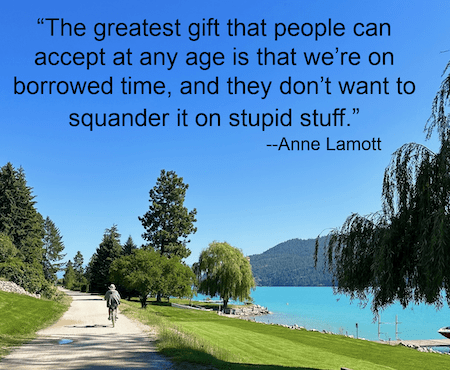 Last spring a neighbor here in Tucson recommended a book. This neighbor, Jeff, told us that it was one of the most important books he’d ever read. How could we not be intrigued? Thom read it first and then through the summer I took my turn. What book? Written by a man named Frank Ostaseski, this book is titled The Five Invitations. What is most captivating is the subtitle—Discovering What Death Can Teach Us About Living Fully. And while that might seem to be an unusual topic to take along with us on a summer vacation, it really wasn’t. As the book makes perfectly clear, if you aren’t making the most of your life in every moment—right now—how will you do it when your time is over?
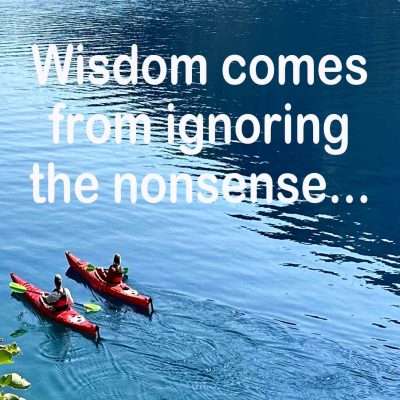 How many times in the last few months (or years) have you heard someone make a statement that was so bizarre and outrageous that you could barely believe anyone could think that true? I have—more than once. It’s tempting to just roll my eyes and try to run in the opposite direction. That, or silently accuse them of (among other harsher judgements) not being able to think critically. But unfortunately, those actions don’t seem to be isolated. In today’s world it seems that such declarations and behaviors are everywhere—in the media, online and out of the mouths of people we meet at the grocery store. We can’t run from everybody who lies and/or makes up wacky assertions. Instead, maybe we ought to learn, and to teach each other, how to critically ignore that input. Or, as William James, the author of The Principles of Psychology wrote, “The art of being wise is knowing what to overlook.”
 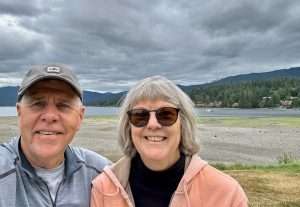 I have been noticeably absent from both this blog and Facebook for the last month, but I haven’t just been sitting around doing nothing. Like many of you, I’m sure your summer has been busy and full doing things you enjoy. If not, why not? Plus, now that Thom has turned 70 and I’m close behind, our focus is on making the most of every day. And with our pledge to go off social media for the month of July, those of you on Facebook might have wondered just how well that particular experiment has unfolded. So, for those of you interested in what we’ve been up to, here are a few of the highlights.
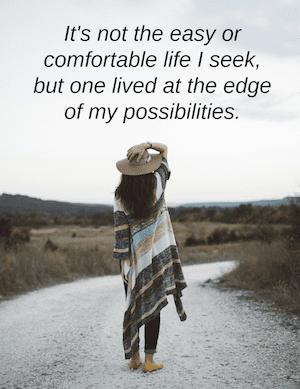 I’m the first to confess that I like my conveniences. I love having both a laptop and a desktop computer so I can write or research anywhere I want. I can’t imagine living without my hearing aids being able to connect to my iPhone so I can take calls or listen to music anytime I want (not to mention hear well!). Speaking of my iPhone, knowing the temperature today and for the next 10 days anywhere in the world seems important, doesn’t it? Or what about Google Maps telling me where I am at any given point day or night? I don’t know about you, but without those comforts (and I didn’t even mention air-conditioning, televisions, a washer/dryer and a thousand other household items) my lifestyle would seem antiquated. Clearly all those things and so much more make my life comfortable. But are they necessary? And is it possible that taken all together there are unforeseen costs that are making me lazy?