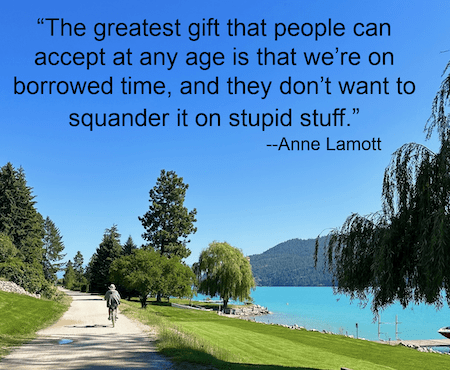
 Last spring a neighbor here in Tucson recommended a book. This neighbor, Jeff, told us that it was one of the most important books he’d ever read. How could we not be intrigued? Thom read it first and then through the summer I took my turn. What book? Written by a man named Frank Ostaseski, this book is titled The Five Invitations. What is most captivating is the subtitle—Discovering What Death Can Teach Us About Living Fully. And while that might seem to be an unusual topic to take along with us on a summer vacation, it really wasn’t. As the book makes perfectly clear, if you aren’t making the most of your life in every moment—right now—how will you do it when your time is over?
Paradoxically, during the summer I read over ten different novels of all sorts of genres. I mostly picked them because they were fun and easy to read. At the same time, I slowly picked my way through The Five Invitations. That’s not because it was a difficult read, but because it was more like a meditation on life. Each chapter invited me to pause and reflect and seemed to require time to absorb and contemplate.
In case you are wondering, there is nothing about the book that is morbid. In fact, it seemed to invite clarity and richness into each moment. That makes a lot of sense because Ostaseski is a Buddhist teacher and the cofounder of the Zen Hospice Project. He also speaks internationally and has been honored by the Dalai Lama and many others. Through touching and sometimes even funny stories and examples, Ostaseski leads readers through a journey of introspection around the subject of impermanence.
Interestingly enough, even though both Thom and I found the book and its ideas fascinating, it was difficult to find others who want to talk about the subject. In our culture, talking about death and/or dying isn’t popular. But isn’t that a problem? After all, it is the ONE EXPERIENCE that we will all share. In fact, as Ostaseski says, “We cannot be truly alive without maintaining an awareness of death. Death is not waiting for us at the end of a long road. Death is always with us, in the marrow of every passing moment. She is the secret teacher hiding in plain sight. She helps us to discover what matters most. And the good news is we don’t have to wait until the end of our lives to realize the wisdom that death has to offer.”
In 2000, Ostaseski was invited by Bill Moyers and the producers of the TV program On Our Own Terms to be part of a six-hour documentary about dying in America. In preparation he came up with five invitations as a way to honor the lessons he had learned sitting bedside with so many dying patients. Not only does he believe they are important for those coping with the dying process—but also, they are equally relevant to living a life of integrity. As Ostaseski says, “We stop wasting our lives on meaningless activities (and…) instead of pinning our hopes on a better future, we focus on the present and being grateful for what we have in front of us right now.”
So, what are the five invitations?
- Don’t wait. Ostaseski says, “Don’t wait is an encouragement to step fully into life. Don’t miss this moment waiting for the next one to arrive. Don’t wait to act on what is most important…be present.”
- Welcome everything, push away nothing. According to Ostaseski, at the deepest level this invitation “asks us to cultivate a kind of fearless receptivity (and…) to welcome everything as an act of love.”
- Bring your whole self to the experience. At the core of this invitation is the assertion by Ostaseski that, “Real altruism isn’t self-sacrifice for the benefit of others…arising from some guilt-driven sense that we should be good, we should be nice, we should be kind or helpful. It is a profound recognition that self and other are not fundamentally different only apparently different.”
- Find a place of rest in the middle of things. Many of us tend to think of rest as unproductive or lazy but Ostaseski says no. He believes that resting is an awareness that releases us “from the habits of managing our circumstances and striving for control as ways to avoid pain and gain pleasure.” Instead of trying to fix or fight with any experience, we open ourselves and accept what is right in front of us.
- Cultivate the don’t know mind. Let’s face it, we don’t know nearly as much as we think we do and can control even less. We don’t know what happens when we die, only that we will. We don’t even know (for sure) what will happen tomorrow. As Ostaseski says, “Remember this, if you can: everythingcomes and goes in awareness. That is the ground of who we are. The rest is just smoke and mirrors.”
There is obviously a great deal more to each of these invitations. As I said in the beginning, they are a sort of meditation on acceptance and awareness of living every day as fully and completely as possible –right where you are. As for those who are nearing the end of their lives, Ostaseski suggests we allow others to pass in their own way. He says, “No matter how noble our intentions, we need to resist the temptation to act on our own biases or impose our well-meaning advice or spiritual beliefs on those who are dying.”
During the last few years I’ve read several books, listened to quite a few talks and even attended a “Death Café” in Ajijic, MX (more about that in another post.). So while I am not particularly fearful about the act of dying, I still have quite an aversion to pain and/or loneliness at the end of life. This book helped me to be more accepting of whatever happens (my own or in another) and observe it with openness, curiosity and acceptance. Ostaseski says repeatedly that there is much to learn at such a pivotal time of existence—especially if we approach it with an open mind and heart. In fact, he says, “…it can be an unprecedented opportunity for transformation.” I’m willing to give it a try.
Otherwise, I don’t always remember every morning when I wake up how precious my life is—but I’d like to. After all, it is far too easy to take the gift of life for granted—or even worse, just let it slip by without a thought. Maybe by contemplating how change and death are inevitable, inescapable and woven into the very fabric of life, I can learn and flow with whatever is to come. Perhaps the SMART approach would be for all of us to do attempt to do the same. What do you think?



Funny–as I started reading your post, my first thought was about Death Cafes. You’ve already been to one!
The practice of contemplating and accepting death is central to so many wisdom traditions. It is pretty amazing that in our culture we “whistle past the graveyard” and shield ourselves from any reminder that what is born in time will end in time, including us!
When I was 11, my best friend had cancer and died. Even though I spent a lot of time with her over the year that she was sick, her terminal diagnosis and impending death were never acknowledged or discussed. My mom wouldn’t let me go to her funeral. She thought it would be too sad for me. I have always regretted not being there. (I’m not criticizing my mom — that’s typical of how people thought then.) It made a lasting impression on me about being honest about dying and death.
I love these five invitations. Each one is an entire wisdom practice in itself. And how affirming these invitations were for me as I try always to live in resonance with each one of them. In a humorous summary, I will share the quote on the socks I wore all last year during my experience with cancer: Carpe the f–k out of this diem! Haha!
Hi Galen!
I love talking about Death Cafes because even though so many people “say” they want meaningful and deep conversations they avoid conversation about end-of-life experiences as much as they can. How more deep and meaningful is taking the time to look at birth, life and yes, passing, is there? And again, at least the Death Cafe we went to wasn’t morbid in the least! We talked about our lives and all the different directions people take moving through them. A very rewarding experience.
And I’m not surprised that you would like these invitations. The author is very “zen buddhist” so very much in alignment with your writing. I trust you are doing well and staying healthy…and yes, “Carpe the f–k out of this diem!” ~Kathy
Hi, Kathy:
As always, I so appreciate your thoughtful and helpful posts. I’m definitely going to check out the Five Invitations. A little bit of synergy here as it relates to my recent post in my grieving process. But it also relates to the book I’ve been reading — Finding Joy, a conversation with the Dali Lama and Desmond TuTu. Life is definitely what we make it and on the continuum of life there is both joy and sorrow. It’s our response to it all that makes all the difference.
Best always.
Hi Kate. I followed the link and went to your blog to read your latest post. So very relevant to this post of mine. https://kateslonglivedlife.home.blog/2024/09/27/guess-im-not-done-yet/. I very much agree with you when you say, “Life is definitely what we make it and on the continuum of life there is both joy and sorrow. It’s our response to it all that makes all the difference.” Thanks for sharing this with all of us. ~Kathy
Thank you Kathy, for your continued insight into practical ways to live, age, and improve our mental and personal attitudes. I will likely read “The Five Invitations”. I like the concept. Years ago upon having to deal with an undesired divorce I joined a “divorced persons” group to deal with the issues that I was confronted with, including the loss of being near my four children. I was introduced to the book, “On Death and Dying” by Elizabeth Kubler-Ross. The idea was that the loss of divorce was much like a death and that people go through the five-steps of grief for divorce much like that for an actual death of someone close to you. I became a helper-facilitator for that group, assisting others dealing with the loss of a spouse and family in that way. In similar fashion to your description here, I learned much about myself and eventually happily remarried, and I ended up taking full-custody of my kids, raising them through Junior High and High School and seeing them off to their eventual adult destinations, be it education, work, marriage, and life, really. I am in agreement that we must live today, not particularly focus on things we cannot change, and to plan for continuing future accomplishments. Another philosophical book, that many people know is “Man’s Search for Meaning” by Richard Frankl. He was a holocaust survivor of a WWII German prison camp. He asked the question as to why some people there gave up and perished, and others, in the exact same circumstance, survived. Positive outlook, hope, and the concept of a purpose contributed to those who survived the most dire conditions. I read that one for the first time, when in the military, missing friends and family, and it prompted me to be grateful for every friendship, life event, joy, and memorable and unforgettable experience. As a result, I’ve been blessed with many fine times, friendships, and accomplishments, and the “regret-word” is pretty rare in my vocabulary. Had I succumbed to other paths, I’d be the worse for it — not to say life’s been that proverbial “rose-bed”, it has not. But here’s to say “thank you” for this great reminder to live life to the fullest, now, today, and also as we find ourselves on that path of our own eventual demise and forever-destination. I’m grateful for your timely advice and inspiration.
Hi Chuck! Thanks for your comment as always! And yes Elizabeth Kubler-Ross is an icon in the field of death and dying. Like you point out, she is well know for her work into loss and grief and how that applies to so many stages of our life. How great that you found it so useful in your experience that you were able to share it with others.
Plus Viktor Frankl is always helpful when facing difficult times and circumstances. As you say, he is a GREAT reminder that we can always choose how we respond to a situation no matter what. Not easy for sure but possible. Thanks for your thoughts on this! ~Kathy
I’m a little surprised that you found a lot of reluctance to talking about the subject of life until death (after all, there isn’t much we can do about the actual point of death and after). Who wouldn’t want to make sure we live the best we can until then. The list of Five Invitations makes a lot of sense. I can’t claim that I am consistent about each one, but I do my best.
Best to you and Thom… are you all packed and ready to go?
Hi Janis! Thank you for pointing out the paradox (?) that this book and the idea that talking and thinking about how death and dying can actually help us enjoy and embrace living life to it’s fullest. I don’t think that everyone gets that. We have found that when the topic of dying comes up, it makes many people uncomfortable and that’s pretty much the end of it. I agree that nearly all of us think that we want the best life we can live until then…but avoiding the topic of death tends to be the elephant in the room. And sooner or later it will trip us up. This happens with both the practicalities (wills, final wishes, health care directions, etc.) but it also touches the mental and emotional elements surrounding our fears and resistances to dying. This book tends to address the psychological approach but as you yourself have written, there is plenty that we can discuss and prepare for regarding the practicalities. I think what the author is attempting is to make us think about how we want to live knowing that there is finality about it…and cherishing everything as we go.
Not leaving for a couple of weeks! Happy hour would be good! ~Kathy
Kathy, we lived daily reminders of what could be as we watched my MIL decline for nearly two years. Every day was a wake up call to live mindfully and fully. We are doing our best to honor those lessons.
It’s too bad your club isn’t interested in the book. I would love to be in your discussion. Thanks for sharing.
Hi Suzanne. I’m guessing all of us have examples of those we love and care for pass on…and that some are in ways we hope to model and others we hope to be different from. And if we can walk away with the awareness to live more mindfully and fully–then so much the better. Not sure whether I’ll be able to put together a book club wanting to discuss this book–but who knows? Getting to share it with all of you is the next best thing! Thanks for your thoughts. ~Kathy
I’m reminded of the philosophy of stoicism & reconciling with the concept of death in order to engage in life. I’ve been privileged to journey with many bereaved people as a bereavement support worker. I am forever in awe of the tenacity of the human spirit. I also ponder people’s reluctance to discuss death although I find it’s a more common topic in my circle of folks in our 7th & 8th decades. My mom died 1 month ago in a long term care setting. I was appalled (?) at the lack of awareness of some of the nursing & care staff. I was so grateful to be present at my mom’s transition. I laid with her in my arms as she took her last breath.
Dear Mona… I am touched by your sweet memory of your mom’s passing. I also agree that the topic of death and dying seems more “relevant” as we age…I think we tend to believe that we will live forever when we are young. And of course our culture is so obsessed with youth and constant growth and “reach” that we avoid any topic that seems to oppose that. But my thinking, and I’m guessing a lot of us too, is that there is a value and richness at EVERY age and every change or awareness. I guess this is part of mine now. And as I hope I communicated in this post, I’m finding that is allows me to cherish more and more of my days and life goes on.
Thank you for sharing your experience and your memories of your mom’s transition. May we all have loved ones with us with your awareness when our time comes. ~Kathy
Hi, Kathy – Your reflections on The Five Invitations are both thought-provoking and inspiring. The idea that death is not a distant event but something that can guide us to live more fully right now resonates deeply. I appreciate how you highlighted the importance of presence, acceptance, and openness in both life and death. These invitations seem to offer a gentle yet profound reminder to embrace every moment without waiting for some “perfect” time to live. Thank you for sharing this perspective—it’s an excellent reminder that awareness of life’s impermanence can truly be a path to greater richness and meaning.
I hope that you and Thom are well.
Hi Donna! Thank you. I appreciate your reflections on this post. As you say, remembering the value of impermanence (and that includes impermanence of ALL things!) helps us to value and appreciate so much more in our lives in spite of how it happens. And while I am and will likely always be an optimist, I don’t think being aware of the passing and changing of all things negates that–and I’ll bet you don’t either right? We can’t know, we don’t know what each day will bring–but somehow just being aware of how temporary everything is seems to make it more precious. At least that is how I plan to live today! Thanks again for your thoughts. ~Kathy.
P. S. And Thom and I are good! Hoping you and Richard and your family are as well!
At the end of the day, it’s all common sense. We just don’t act upon it. So, yes, death is entertwined with life. It’s the thought of death and wanting to have lived a full life that guides us through everything we do. If we do it consciously. 🙂
Hi Liesbet! Yes I could agree it is common sense but as you say, we seldom act on it. Our culture tends to be obsessed with youth and consumption and that doesn’t really mesh with the idea of impermanence and change does it. What it does for me is put me in a state where I cherish whatever is happening to the best of my abilities. It also takes away the fear of “what might happen” and just accept what “is” happening. Big difference IMHO. And YES to staying conscious! ~Kathy