 Open any magazine or watch any number of tv commercials and you’ll soon come across an ad that will tempt you with the possibility of looking young and living forever. Anti-aging products make the promise sound within our reach, while technology and the medical industry are spending billions to make it appear possible. But is it true? While none of us wants to admit that we are going to die, how many of us really want to live forever? That provocative question is raised in a new book titled, How to Live Forever—the Enduring Power of Connecting the Generations by Marc Freedman. I was so intrigued by the title that I contacted the author and requested a review copy just so I could discover a new way of looking at this age-old question.
I think if most of us are honest we don’t want to live forever. We may even agree that it is wrong to deny aging and that getting older has more benefits than we originally imagined. Instead, what none of us want is to lose is our capacity for physically getting around, to enjoy life, or to make our own decisions and choices. But, up until now, the current solution has been to act as young as possible, exercise like crazy, clean up our eating, and embrace “anti-aging” any way we can. Freedman offers another way of looking at it. Instead of seeing “aging as playing” or trying to “cheat death,” he suggests that we seek generativity.
Okay, so what is generativity? This word was first coined by a psychoanalyst named Erik Erickson back in the 1950s. Yes, whether us baby-boomers are aware of it, the concern about what happens as we age has been pondered for decades. Back in the mid-1900s the push for retirement was often seen as more complex than just letting people relax after a long hard life of work.
According to Freedman, the idea of retirement started with a way for business and society to push old people out of the mainstream in the name of increased productivity and efficiency. If society and business could convince us that we “deserved” to step away from the world and only focus on ourselves, then society could park us away somewhere and throw us a few crumbs to keep us from bothering them and the GPD. Those crumbs were the idea that we could return to our youth and cheat death.
But a few people like Erikson saw this as problematic and spoke out about it. He wasn’t the only one. An article that appeared in Architectural Digest in 1956 by a man named Lewis Mumford read, “To cause the aged to spend all their time glued to a television set is to damn them prematurely to a second childhood.” This author confirmed that the main culprits were “specialization, mechanization, institutionalism, in a word, segregation” all ideas that appeared to be efficient on the surface but led, in his view, to the equivalent of “early euthanasia.” And although many of us have more options than merely watching television as we age, the segregation of seniors in housing projects, ranging from retirement villages to nursing homes, is growing by the minute.
So where did the idea of generativity surface? In his work, Erikson began teaching and writing on the evolving ego of children and adults as they aged. He eventually refined it into Eight Primary Stages showing at each stage we face necessary dilemmas that lead to either healthy or unhealthy development. While mostly concerned with children and young adults, he eventually highlighted what he called a “second stage of adulthood” to be “Generativity versus Stagnation.” It was here that Generativity was born.
Generativity basically means a concern for one’s legacy. In other words, a concern for others beyond self, even beyond one’s family, and innate need to nurture younger generations. Besides the desire to “make one’s mark on the world,” it can also be explained as a desire to make the world a better place. This is obviously contrasted by the idea of stagnation. In that place a person feels they never have, and never will, offer something beneficial to the world or other people. The obvious downsides are feelings of isolation and disconnection from everything, everyone, and life itself.
That’s why Freedman is convinced that “…the real fountain of youth is the fountain with youth. And the only way to live forever is to live together, not only in the present but from generation to generation.” But he doesn’t just stop with the idea that we help others so that we can feel our lives matter in the end. Freedman cites evidence that shows, “that those in middle age and beyond who invest in caring for and developing the next generation are three times as likely to be happy as those who fail to do so.”
Again, this doesn’t mean that if you are like me and don’t have your own children, or are disconnected from those you do have, that you are out of luck. It just means that something within all of us resonates with the idea of helping those younger than us and leaving a legacy that will survive us when we are gone—and those “others” are everywhere. In fact, Freedman is convinced that young people need older people as much as we need them.
Freedman then goes on to share a variety of stories about people who are offering themselves in small and large ways to enrich their own lives and the lives of younger than themselves. In addition, he lists several organizations (some of which he’s involved with and started himself) in which others (like you and me) can get involved with as well. A couple of those are:
Experience Corps—Similar to a domestic Peace Corps
Nesterly—A high-tech way to connect older people with younger people
org—helping people create 2nd Acts for Greater Good
Generations United—linking senior centers and nursing homes to early childhood centers
Gen2gen.org—bringing generations together to help realize the potential of longer lives, the potential of every child, and the power of older and younger generations working side by side for change
Freedman is convinced that the key to our own immortality is tied to the idea of generativity. He continues to point out that our actions don’t have to change the world, sometimes all we need to do is to know we have helped change one other person’s life—especially those who need a hand-up. He also offers quite a few other suggestions for living forever. Here are four I found most meaningful:
Accept mortality— “Living mortal starts with being mortal, with accepting that life is a journey with a beginning, middle, and an end…”.
Prepare yourself for this new stage of life— “the most satisfied people I know are ones that welcome this new, encore state of life beyond the middle years, prepare for it, and lean into its unique features to find happiness.”
Focus on relationships. — “In the words of George Vaillant, ‘Relationships matter most. Full stop.’”
Get proximate— “If you want to stay connected to younger generations, including family and those beyond our immediate kin, we need to be conscious about housing, activities, religious congregations, and the other places where we spend our time. Just being physically proximate matters.”
As I said in the beginning, I don’t think most of us, deep down, believe we will live forever. But I do believe that most of us hope to be remembered fondly. When we take the time to reach out and help others, we benefit as well. As Freedman writes, “An extensive body of research on purpose, generativity, relationships and face-to-face contact makes it plain: engagement with others that flows down the generational chain will make you healthier, happier, and likely longer-lived. It’s the real fountain of youth.” The SMART perspective might be to keep that in mind no matter what our age.
Okay, your turn. Have you given much thought to how long you want to live? Do you think the idea of generativity has merit? Have you been active with genertivity in your own life so far? If yes, please share that and any other thoughts on this idea in the comments below.


Hi Kathy,
Terrific post and discussion! I’m a staff member at Encore.org, which author Marc Freedman leads.
Just wanted to mention that folks can find a free discussion guide for the book HOW TO LIVE FOREVER at https://encore.org/discussion-guide/
And if you’ve got a great idea for a project that brings younger and older generations together to help kids thrive, apply now for a $250 grant from the How to Live Forever Fund at https://encore.org/howtoliveforeverfund/
Thanks!
–Stefanie Weiss, sweiss@encore.org
Hi Stephenie! Thanks for popping in here and adding a few links to more of Freedman’s work. And YES to anyone who can come up with ideas and projects to link us all together. ~Kathy
I have encountered Lewis Mumford’s writing before, and I am familiar with Erickson’s developmental theory. Giving back to society, and contributing to improving the lives of future generations have always been important to me. I guess that explains why I became a professor of Education.
I always loved teaching, mentoring grad students, and in the latter part of my career, mentoring new academics and new managers. Research and academic writing, which I still continue to do, are ways that I contribute knowledge to future generations.
Now that I have retired, I am a member of a local service club, and volunteer a few hours every week to support local events and do fundraising to help local people in need as well as people around the world.
But the best and most satisfying form of generativity for me has been raising my three children and being part of their lives and ongoing development, and now also an active participant in my grandchildren’s lives.
Jude
Hi Jude! I can only imagine but I’m guessing that most parents feel that raising their children and then helping to raise their grandchildren is one of the most important things they can do. And actually from my perspective anyone who chooses to have kids should hopefully do the same. But for all of us who have chosen something different, that doesn’t mean that our connection to those younger than us can’t be as equally rewarding–and again, we get to choose the age groups!!! What I felt was most important in this book was the reminder than none of us got to where we are today without the help of 1,000s of others. And may we each add to that chain of connection in any way we feel called. ~Kathy
I’d say we don’t all have to do the same thing to help future generations. Some of us have kids, others help kids, still others help the environment. But maybe this explains (I’m being honest here) why I volunteer to help kids read and write, but can’t find the interest to do meals on wheels for the old folks. Maybe it’s also a reason why B and I have resisted self-segregating ourselves into an age-related community.
Hi Tom! Once again it comes down to “rightsizing” doesn’t it???? 😉 I agree that because we are all so different there isn’t a “one-size fits all” approach. I also tend to want to hang around those younger than me these day (not kids but adults) but at the same time I’m learning to appreciate it isn’t that I want to avoid old folks, what I REALLY want to do is avoid old thinking! And I also think it is important for us to realize that we are making a choice for age-segregation (or not) when it comes to where we plan to live for the remainder of our lives. Thanks for you thoughts as always! ~Kathy
I loved this post and, judging from the comments, I am not the only one! What a great topic! I’ve come to terms with many of the issues around longevity, and am certainly at peace with the idea of not living forever! I agree that retiring to a retirement home is a recipe for leaving active involvement in life—and a waste of the wisdom and energy of older people. Golfing and playing bridge, etc. seems to me such an unsatisfying way to spend these years—yet I know countless retirees who believe their work is done, and it’s time to play. There is so much do do in this world that will benefit younger generations! We don’t have to think along the lines of ‘saving the world’—acting locally to make a difference would be enough.
Hi Diane! I think it is so very important for us all to come to terms with what longevity and what a long life look like for us. Good for you for thinking that through. And I have to admit that I have been somewhat tempted with the idea of a “active retirement community” because where I live there is a HUGE one with fun activities going on every single day. We actually looked at a home there a while back and considered it because most everyone we talked to LOVED living there. But I think the decision for us came when we saw the huge list of rules you have to follow to live there AND the fact that everyone there looked so old (hahahaha!) While I realize I am fitting into that category now, I also realize that I enjoy mixing it up with age groups. I really don’t want to live where everyone looks like me and talks like me etc. And I agree…who wants to just play all day? Where we decided to live is in a very walkable, middle class neighborhood with a nice ethic mix, very intergenerational (meaning old AND kids) and it feels good. While it might not be as close-knit as some retirement communities, it mimics life so much better and I like that. Of course with that said, I am also very committed to the idea of Rightsizing in that we all need to find places where we are both happy and content–and able to contribute in a way that provides meaning–so we all have to make that decision on our own. Thanks for your thoughts! ~Kathy
Great post about a topic dear to my heart. I wrote about this concept a few years back. An excerpt:
The items below are from the Loyola Generativity Scale (LGS).
Read the following six items and mark:
O if the statement never applies to you;
1 if the statement sometimes applies to you;
2 if the statement often applies to you;
3 if the statement always applies to you;
Then add up your score. Men, women in their 30s, 40s and 50s usually score 11. Younger adults and adults in their 60s and older usually score slightly lower.
___ I try to pass along knowledge I have gained through my experience.
____I have made and created things that have had an impact on other people.
____I have important skills that I try to teach others.
____If I were unable to have children of my own, I would adopt children.
____I have a responsibility to improve the neighborhood in which I live.
____I feel that my contribution will exist after I die.
Thanks to Dan P. McAdams for the inspiration from his article GENERATIVITY:The New Definition of Success
Hi Beth! I sure hope I’m not the only person writing about Generativity! But I found your comment interesting because it suggests that if you can’t have kids you should adopt if you want to be generative. Sorry but I don’t think I agree with that. So I went to Loyola University Generativity Test (and remember Loyala is a Catholic School) and discovered that there are actually 20 questions on the list offering a much larger perspective. It’s a lot easier to score points in a 20 question quiz rather than a 6 question quiz! That sort of confirms that after reading Marc Freedman’s book one’s personal children aren’t necessary to qualify, and he actually makes the point that as long as you are working to benefit future generations then you are fully practicing Generativity. ~Kathy
Hi Kathy, I wrote my post quite a while ago, so I’m glad to see some addenda added to the test. As a former teacher and then an L&D RN who always took the time to remind parents, new and experienced, the important of parenting and what they can pass on to the next generations–I applaud the concept of generatively, but am often amazed that many have never heard of it. Thanks for your update.
Hi Beth…yes, I agree that generativity needs to play a bigger role in the future of us all. The younger generations NEED the wisdom of those older and the older need the energy and enthusiasm of the youth (not to mention a few tech lessons thrown in there) When we connect and work together we are ALL better! Hopefully those of without kids and those of us with kids know this is something we can do throughout our lives. ~Kathy
When I read this blog the first thing that came to mind was a movie that I saw as a young boy around eight or nine years old. The name of the movie was Cocoon. It was about the elderly which lived in a retirement community. They decide to trespass into this home which had an indoor pool to swim. Each and every time they swam in the water they felt as if they were younger and more youthful. Kind of like a fountain of youth.Today there is that saying which states that age is just a number, but as we all know the older you get the more difficult it gets to even walk up a flight of stairs. Now that I have learned through education age is just a number, but the aging process is something that begins to take place from the time of conception. In order to slow that down we tend to look to Science and maybe even medicine. We watch what we eat attempt to try various diets and exercise. Vitamins and supplements are part of the everyday life. Maybe even some skin rejuvenation products, Botox, liposuction,implants, face lifts and etc. With so many options their is still no way to slow down or even abrupt this process of aging. How can we stay young? Surround ourselves with those younger, older, and our age. This keeps us in the know with the growing trends and also technology. What can we be remembered by (legacy). I think it is important to share what knowledge and wisdom you may have about this life that way it can be passed on from generation to generations too come. It could even be as simple as read your bible daily. It has all your answers to not only this life but the life to come after death.
Hi Manuel! I appreciate you bringing up that movie Cocoon because it addresses some of the problems with our current model of aging in the U.S. It is assumed that older people should just be parked away in a retirement village because they have nothing to really offer younger people or the world. Fortunately, the water they experience in the pool helps them feel better, but those still alive at the end of the movie decide to leave Earth and go off on an adventure. Perhaps the greatest adventure would have been for them to fully engage in our world in deeper ways???? I can’t help but wonder. The author of the book, Marc Freedman isn’t crazy about retirement villages for that same reason. He feels they isolate too much wisdom and give older people the idea that they have nothing much to contribute so they might as well go and play somewhere until time to die. I think he (and I) certainly agree that it is far better to surround ourselves with all age groups. Surely older people can learn a lot from younger people at the same time older people are sharing what they’ve learned as well. Lot’s of ways to do this if we take the time to imagine. Thank you so much for your comment! ~Kathy
A very interesting concept and one I had not thought of on my own. I agree that the more time that is spent between grandparents and grandchildren ensures or rather secures the legacy. I am fortunate to have both sets of grandparents still alive and am even more fortunate to have them living within a 5 mile radius of me. The moments I have shared with them and continue to share with them are cherished and I try my best to dedicate time with them as much as I can so that my daughter has the opportunity to create memories too. My grandparents both state that being around family keeps them young and seeing us happy and thriving is what their hard work was for. I know that their time on Earth is limited but to me they will live forever within me, through memories and love.
Hi Marlene! Thank you so much for providing a perspective from a mother to her parents (and her children’s grandparents). In this day it is great that children have a connection to those elders in a way that many are losing. Not only is it a benefit for your kids, like you say, it is a benefit for your kids, and ultimately a benefit to you as well. How great for you all to learn from each other that life is a journey that goes through stages. And hopefully, the lessons your children are picking up will not only help them grow into strong and happy adults, but they will remember it and pass it on when the time comes. Again, thanks for sharing this perspective with all of us! ~Kathy
I agree with you that – if we are honest – nobody would want to live forever… if we keep aging. I think if we could remain a certain age, say between 40 – 60, some of us might like to attempt living forever. I think it would get exhausting and demoralizing at some point, though, the way the planet keeps being abused.
All this being said, I agree that most people would prefer to leave a legacy, to make a difference for at least one person. To be remembered. You and I achieve that with our writing and our blogs, and this concept is probably one of the main incentives for authors to keep cranking out new books.
Another thought that popped up in my mind as I read your post is that quite a few movies and series are being produced, covering different generations. The film “Life Itself” comes to mind (which I recently watched on the plane) and the TV series “This is Us”. Those stories put life (and the impact of generations) more in perspective for me.
Hi Liesbet! Thank you for your thoughtful response to this post. I think it is difficult for us to imagine ourselves as older, especially if we are feeling great and everything is unfolding as we like, but at some point we start realizing that things are changing, that WE are changing, and we start looking around at others our age and the experiences we have had and realize that this will not go on forever. And nor should it be, right? If you are like me you are sort of convinces that life is about growth and evolving and if we can’t keep doing that, and reaching back and helping others do the same, maybe this “stint” is over? And I completely agree that those of us who write and blog tend to recognize that our words are our message to others about living–and that is perhaps the legacy that we hope to be remembered by. I recently watched the movie with Shirley McClaine called, “The Last Word” that was like the ones you mentioned. While life isn’t always quite as perfect as the movies or a TV program, I think there may be so truth to the message they portray. Thanks for your thoughts on this! ~Kathy
Interesting concept. As you know, we are child-free also. And (I’m whispering here as it may be an unpopular opinion), I don’t have a great desire to be around kids… at least younger ones. I don’t dislike them, I guess I’ve just never been that maternal. That being said, I think giving (time and/or money) to organizations that preserve natural habitats, promote climate science, and support the greater good is a way to give back too. I probably won’t see much of the hoped-for positive outcomes in my lifetime but future generations will.
Hi Janis! As I mentioned in my comment to Pat, I’m not a big fan of little kids either. If you can’t have a conversation with them then I quickly lose interest. But I have found that I am a “people” person so for me I really enjoy hanging around with young adults–or any adult that is curious, open-minded, and dare I say SMART? 🙂 However, Marc Freedom doesn’t specifically say that supporting future generations has to look one way or another. He actually makes a big deal of the quote that says, “The true meaning of life is to plant trees, under whose shade you do not expect to sit.” —Nelson Henderson. Anything we do like that is connecting us to the future and providing a meaningful life. You’ve got this! ~Kathy
I am 78. I worked in medicine for 40+ years as an academic, with a PhD. When I asked MY physician, upon my retirement, how I might live to a “ripe old age” he responded, “Don’t smoke and wear your seatbelt “. Having never smoked and wearing my seatbelt on the road, I am well on my way!!!
Hi Jack! It sounds like you have found your own formula. I’m guessing from your post you also have a good sense of humor. Good for you for finding your own “key” to positive aging. ~Kathy
What a fascinating concept! The media bombards us with youth and “shoulda-woulda-couldas” of how we should be, no wonder our society is so hung up on the idea of living forever. I sure don’t! But connecting with others of all ages at this stage of our lives as we retire is necessary! Most other cultures revere their elders and seek wisdom from them. Not so much so in our Western Culture. Most of us don’t even want to live with our aging parents for fear of staring at the reminder of our mortality on a daily basis. Our Western culture infrastructure does not really allow for successful living with our elders as well. Blogging and being involved in that creative, online community has been a blessing to me, and has allowed for real-life friendships! I am also blessed to be able to “give back” as a university educator in my second act as I “train” the next generation of leaders in the recreation and leisure profession. Just connecting with young adults is exciting and to see those aha moments, well, it makes my day. Hans and I are looking forward to our role as grandparents, with one grand-daughter already, and hopefully more on the way! Great food for thought, Kathy and Happy New Year to you!
Hi Terri! Thanks for sharing your personal experience of teaching with us. I think teachers do have an advantage–and experience it regularly–of seeing how they influence and benefit others with their subjects. But then when you think about it, most all of us are teaching others by our actions (and inactions) just through observation. If we put a little more intention in it, perhaps we could all make a bigger difference. And you have the advantage to both “teach” and share the positive news about aging with others–how great is that! And Happy New Year to you too! Your recent travels over the holidays looked wonderful! ~Kathy
Loved this post, Kathy. Being with people younger than ourselves is important for “leaning in” to this new stage of life. It benefits everyone. Having taught for many years I was always amazed at what the kids (and my younger colleagues) could teach me. I do miss that interaction; I will have to be more purposeful in seeking it out, particularly as my own children are far away.
Accepting mortality is a bit daunting. I am focusing on having the most meaningful life I can for as long as I am physically able. And to be remembered fondly would be nice.
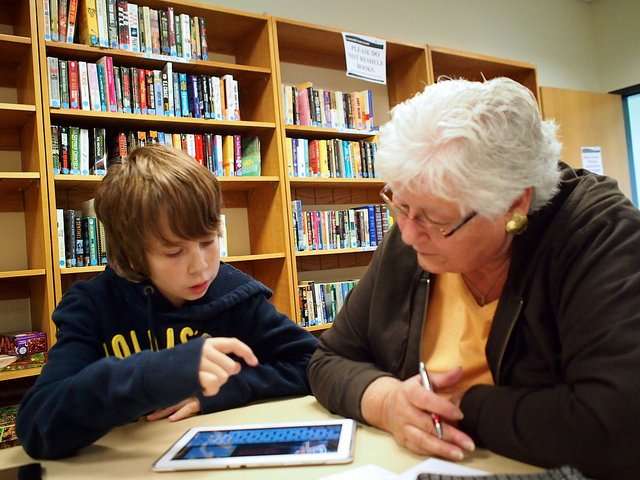
Hi Nancy! Thanks for your thoughts on this and also your perspective as a former teacher. Even though I’ve never been a teacher I have run some classes and workshops and I agree that having younger people in the class always adds energy and life to just about any topic. That’s one reason why I picked the photo for this post that I did. Who is teaching who? From the looks of it, the child is teaching to older women how to use an ipad. I appreciated the book for the reminder that we all can learn from each other if we take the time. And perhaps the most meaningful life is the one where we are very sure of our legacy? ~Kathy
Great post Kathy! My financial advisor, a young woman, says she has many elderly clients in talking about there financial goals and estate will say “If I die”, she says she always corrects them to “When you die”, and often they don’t hear her! Hell NO I don’t want to live to 100 or 95 or 90! Like everyone I want to live only as long as everything is working. I always had misgivings about retirement and other communities that restrict children. I guest lecture one class on entrepreneurialship at the community college and I often feel I get more out of it then the students! Must be the generativity high!
Hi Haralee! Thank you for your great examples of denial! AND your great example of giving back to those younger than you. I agree that it doesn’t have to be kids to be beneficial to others. I think a real key is that connection a person feels when what they say has value to another and you can see it in their eyes. And when you see that, it surely is a generativity high! (I think you should copywrite that term!) ~Kathy
Hi, Kathy – Thank you for this post. Along with confirming a few things that make much sense to me, it has also given me lots to think about. Your first takeaway about ‘accepting our morality’ is critical. Any other option in this regard leads us into a life of denial and disappoint. It also robs us of the joy of being at peace with who we are.
I’m off to ponder more on this subject.
Hi Donna! Thanks as always for your encouragement! And yes, I agree that “accepting our mortality” is an important part of accepting getting older. If we continue to deny either one of them then we could easily miss out on what the best parts of these stages might be. And if my experience amounts to anything, those things I attempt to deny just keep making themselves known, over and over, until I have not choice. Far better to just accept and then look for the gift IMHO. Let me know what you come up with!!! ~Kathy
Kathy, I struggle with generativity a lot. I’ve read some of the stuff on Erkinson’s theory and it has not helped the struggle. Also being child-less (like you) and not (yet) having a strong desire to make a volunteering commitment, I’ve wondered where my generativity/legacy will come from. No, I don’t believe in living forever, but I do want the next 40 (!) years to be happy and satisfying. Where do you believe you are getting your generativity needs met?
Hi Pat! This is a big question for us all at or nearing retirement (or according to Freedman anyone really over 50). I’ll admit I’m not really a baby or little kid kind of person–but once children are old enough to carry on a conversation about the bigger things in life then I find them more enjoyable. A couple of years ago I volunteered as a mentor for local high school girls for 4 years. It was very rewarding and something I felt really good about doing. The timing and schedule fit with my life and I felt it was beneficial for the girls too. But after 4 years it was time for something different. I haven’t found something quite as steady but I have participated in a few projects that I felt good about as well. Just like with rightsizing, I think how we participate with others (no matter what their age) is so individual. I think a real key is knowing that we are connected and that enhancing those connections is both good for us, and the other people (not to mention the world itself.) As far as you are concerned, I would never dare tell another how to contribute, with your talents I can clearly see how you could help others and reap the benefits of such interaction. Good luck. ~Kathy
P.S. I personally believe that those of us who blog also have a gift to offer those younger than ourselves if or when we try to include other age groups. Again, if we believe we are connected those who can understand and appreciate our words are connected to us in a positive way.
Great post Kathy! Most of my life I was convinced that I would die very young. When I realized that I’d be hanging on for a while, my thoughts needed to shift to figure out how I wanted those years to look. I don’t so much care about how long I live but how I live. If I ever have grandkids, I hope to spend time around them – as long as I am not a burden to my children.
Hi Janet! I’m so glad that time has proved you wrong!!!! And what an important question we can all ask ourselves, “How do we want those years to look.” And regardless if you have children, I don’t think that most of us want to be a burden to anyone. Hopefully we have something to live for no matter what our age and the physical and mental capabilities to share that with others. ~Kathy
At every moment we’re aging and mortality is a given. It was concerning to me when a friend bemoaned aging, something that was so inevitable. As much as i enjoy and engage in life, I’m glad to know there’s an end. Or is there? I really don’t know what will happen in the “after life”. I think it’s healthy to embrace every stage of life and engage with all age groups. I play cards monthly at the local seniors’ center where I’m the youngest at 62 and the oldest is 96. I’m always impressed with the wide range of “normal” when it comes to aging. I belong to a community association where I’m the third oldest active member. Each member contributes in his/her own unique way, including the kids who show up with their parents. I’m thinking of my former work life, where I was definitely a seasoned employee. I would sometimes have to remind my young colleagues that I had been in this role longer than they had been on the earth and some of the practices they saw as “new” I had seen come around for the third time. Again, each contributes in his/her own unique way.
Hi Mona! Thanks for checking in on this and sharing your thoughts. Regardless of where our thoughts take us, I am convinced after all the reading I’ve been doing, that we owe it to ourselves and those we care about to think about such things and keep them in perspective. Not only does it make our life more aware, I think it also rubs off on those whose influence lie within our reach. If we can demonstrate to others that growing older is a part of life, just like passing on, perhaps that will bring comfort and understanding. And like you said, i believe we ALL have opportunities to contribute to others –sometimes older– sometimes younger, and it’s that chain that keeps us all connected. ~Kathy