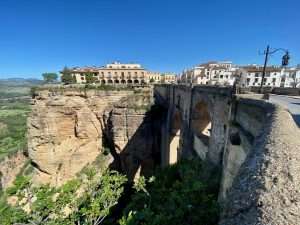
El Puente Nuevo in Ronda
After a great visit in Granada, Spain we rented a car and headed into the countryside. Our destination was a small town named Ronda which is considered one of the “white villages” of Andalucia, Spain. It is a lovely little town. (little compared to the other cities we visited) and a welcome relief from the crowds. As with our other stays, we checked into our vacation rental apartment and walked to dinner. We wanted to get to bed early in order to get a good night’s sleep before tackling our big adventure the next day–El Caminto del Rey.
 One of the main reasons I wanted to visit Spain was to experience Andalucía in the Southern part of the country. For whatever reason I felt drawn to the culture and landscape. Past lives? Who knows? But after experiencing Barcelona we took the train to Cordoba before taking another train to Granada. The highlight there, at least in my opinion, is the Alhambra. This palace and former fortress is considered to be one of the most famous examples of Islamic architecture and one of the best-preserved palaces of the historic Islamic world. Plus, it contains notable examples of Spanish Renaissance design. Sitting boldly on a hill overlooking Granada, it is a must see when visiting. And I purposely selected a vacation rental that provided a view.

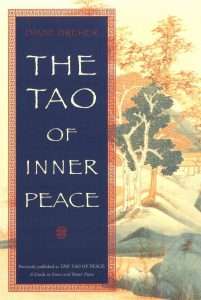 Have you ever heard the saying, “If you aren’t outraged, then you aren’t paying attention?” After all, with all the suffering in the world right now, is the choice to stay calm and centered or happy the right response? How can we stay alert and aware of what’s going on in the Ukraine, with COVID, the climate crisis, rising food prices, etc. etc. and not feel motivated to respond with outraged action? Actually, there is another way. And that way is called the Tao. I was recently given an excellent reminder of that possibility when asked to review the book, The Tao of Inner Peace by Diane Dreher Ph.D. While I’m not exactly a stranger to the Tao, this book offered me clear instruction and insight as to why our inner peace is so very primary. And the more chaotic the circumstances in the world and in our lives, the more we need to access that inner peace. For it is only there that we can ever truly make a difference for ourselves and others.
  Last week Thom and I held a discussion group with friends. Our topic was to share any quotes that we felt had influenced our lives in a long-lasting and profound way. It was harder than you think because all of us love quotes and like me, had hundreds to choose from. Then I found it. My quote was one that I read in an old, old newspaper column by Ann Landers (I said it was old, didn’t I?) It meant so much to me I cut it out and saved it all these years. The fact that it was by one of my favorite authors, Ralph Waldo Emerson, made it even more special. But what has occurred to me since then was how it subtly influenced me all these years and how it became a tribute to what I hoped to be when I got older. I wonder how many of us take the time to consider the “messages” we absorbed when we were younger and how they continue to influence our lives. Did we become who we always hoped to be?
 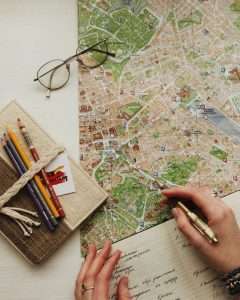 Lately I have been absorbed with planning an extended adventure this coming summer. I enjoy the process of charting out where I want to go, where to stay and what I might want to do. But this morning I heard a great quote that reminded me of something that applies to not only our vacations, but our lives as well. That quote is by a philosopher named Alfred Korzybski who said, “The map is not the territory.” In other words, my “trip plan” is not the adventure any more than a menu is the meal. And while it might appear obvious that our “models” of situations, circumstances or reality are not the real thing—many of us unconsciously confuse the two and then forget we are forgetting! Remembering why it matters could clear up a lot of misunderstandings and disappointment in our world.
 Twenty plus years ago I had a very close friend I’ll call Susan. Shortly after we met she invited me to lunch and I came right out and told her that while I knew a lot of people and had quite a few friends, I was really looking for a very close friend. Was she? In agreement, we then spent over five years talking, laughing, and sharing our lives. I felt closer to her than my own sisters. Then? She ghosted me. Of course, it wasn’t an immediate thing. I knew our circumstances had changes—that we had changed. The phone calls got shorter and fewer, and the times together dwindled. Sadly, it ended a slow death, and I never knew exactly why. I mourned that relationship for many years.
