 This week I’m happy to introduce you to Erica Henault as my guest blogger while Thom and I are traveling. I started following Erica’s blog Behind The Scenery about a year ago and quickly discovered how seamlessly she fits into the SMART Living lifestyle. With a strong intention to grow, evolve, create and be thankful, Erica manages to help us all do the same. Thank you, Erica, for filling in for me and sharing some of your ideas about how every one of our choices can have a profound influence on the quality of our lives. Let’s never take any of that for granted!
I think many of us have reflected on the “sliding door” moments in our life. The what ifs? What might have been? How would my life be different now? I know I have. [Read more…]
 Have you ever heard of the 14th-Century Persian poet named Hafiz? He is another one of my favorite poets and manages to beautifully capture such profound ideas in short phrases. The line in the photo comes from a short poem that says,
 A couple of weeks ago I cohosted a series of four podcasts with Kathe Kline of Rock Your Retirement. Kathe let me pick the topic of each of our discussions. After finding and selecting four articles I thought sounded intriguing, Kathe and I then spent 30 minutes discussing each of them from our individual perspectives. And although the podcasts are currently being edited and won’t be available until August, one of the topics stuck deeply in my mind. That topic is contentment. And while the word and concept sounds vaguely pleasant and benevolent, I must admit that I’m beginning to realize that I’ve overlooked its greater value and importance.
  Many people who find SMART Living 365 through Google or other online search engines are looking for information about Smart technologies. Others might be attracted to the blog thinking it has to do with intelligence or doing the right thing. Yet, if you stick around and read an article or two, you quickly realize that SMART is actually an acronym for Sustainable-Meaningful-Aware-Responsible and Thankful—and those ideas are what I mainly explore here. Plus, now and then I come across information that ties brain science to awareness. So when I found a book at the library titled, You Are Not So SMART, how could I not check it out? My big take-away? Clearly I am not as smart as I like to think I am (none of us are really!) mainly because who we think we are, our memories, and how we see the world often has very little to do with reality. Another way of looking at it—believe or like it, or not—we are continually making it up!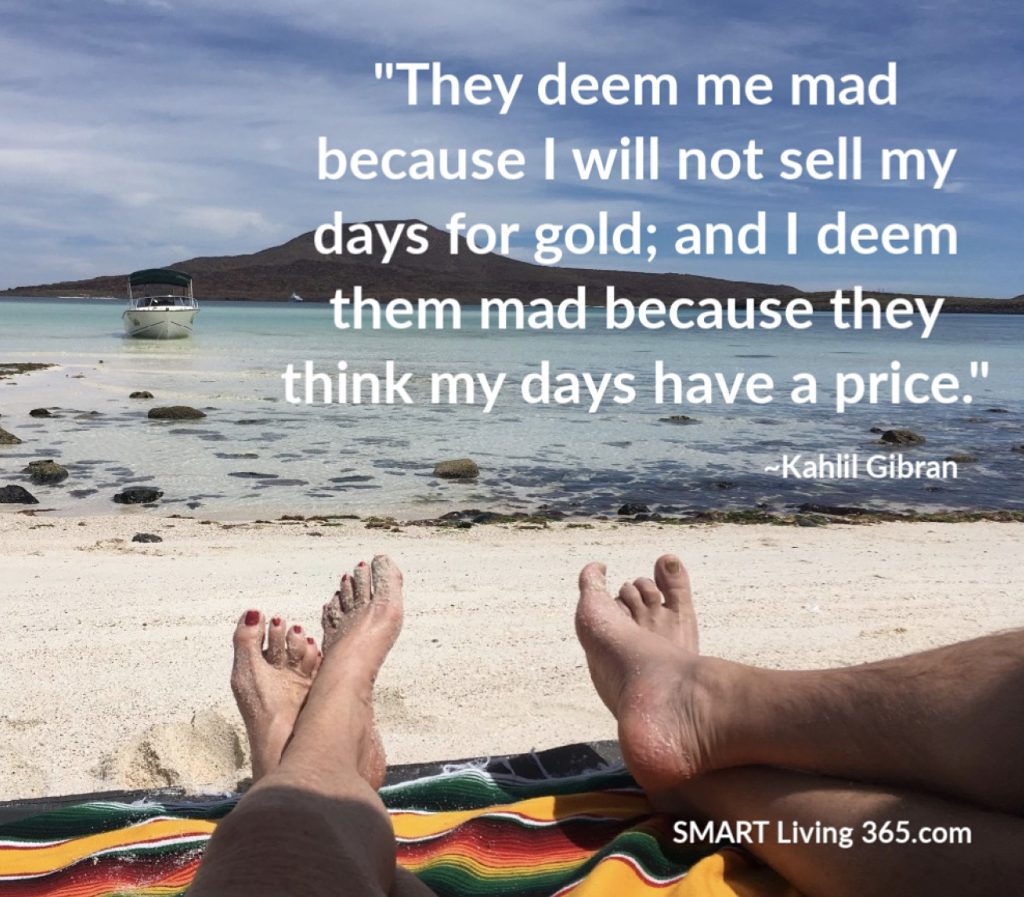
 Have you ever heard the quote, “Comparison is the thief of joy?” That great quote comes from former President Teddy Roosevelt. And I completely agree. But this week I realized that comparison is also a thief to feeling grateful—and without gratitude, how can we feel joy? Of course, like so many issues of awareness, this seems obvious. The key is to remember it on a daily basis. Because if you are anything like me, it’s very easy to fall into the trap of seeing and comparing what others have or are doing—and then overlooking the good in my own life. Fortunately this week, two great examples popped up to drive this idea home. Even better perhaps, they happened to others rather than me. Ever notice how we can often catch behaviors in other people far more easily than in ourselves?
 Every summer for over 25 years Thom and I have rented a house in a small mountain town named Idyllwild for a month. Originally planned as a way to escape the summer heat in our desert valley home, it quickly became an annual retreat of sorts. This sojourn helps us to recapture the joy of summer, hike familiar local trails, and to connect more with nature. The trees, the nearby running creek, the privacy and the quiet are something that feels as familiar as any place we have ever lived.
  I don’t normally think of myself as anxious. I tend to see the bright side of most things and utilize lots of techniques I’ve picked up over the years to handle stress. But truth be told, every now and then something will happen, and I find my mind spinning out of control. Certain triggers will spark, and I’ll wake up in the middle of the night with a crazy loop spinning like a monkey in my head. How about you? Fortunately this week I listened to an online lecture explaining how our minds work in relationship to habit, addiction and obsession. During that talk I learned about the biological process our minds typically use. Even better I discovered a fairly simple way to reduce any thoughts of worry, fear, anxiety or attachment—including those crazy monkey thoughts in the middle of the night. So, if you prefer a good night’s sleep, or are interested in letting go of any fears or stress that might plague you during the day, you might find it helpful as well.
 Most of us are uncomfortable talking about our money. I know I usually am. After all, few of us think we have all we could ever need—even the super wealthy. And if we are lucky enough to feel fairly comfortable about it, we don’t usually bring it up because we don’t want to appear insensitive to those who have less. Or maybe worse, we don’t want to jinx what we have. But, is it possible that how we feel about money is directly related to how we feel about life in general and ourselves in particular? In other words, is our relationship to our money happy, affectionate and at peace? Or is it sad, fearful and distrustful? Getting to the heart of those questions is the focus of a new book by Ken Honda titled, Happy Money—The Japanese Art of Making Peace with Your Money. And some of his perspectives may surprise you.