
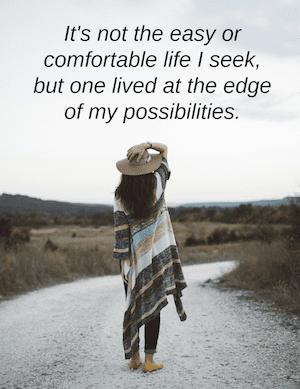
 I’m the first to confess that I like my conveniences. I love having both a laptop and a desktop computer so I can write or research anywhere I want. I can’t imagine living without my hearing aids being able to connect to my iPhone so I can take calls or listen to music anytime I want (not to mention hear well!). Speaking of my iPhone, knowing the temperature today and for the next 10 days anywhere in the world seems important, doesn’t it? Or what about Google Maps telling me where I am at any given point day or night? I don’t know about you, but without those comforts (and I didn’t even mention air-conditioning, televisions, a washer/dryer and a thousand other household items) my lifestyle would seem antiquated. Clearly all those things and so much more make my life comfortable. But are they necessary? And is it possible that taken all together there are unforeseen costs that are making me lazy?
I suspect yes. And that yes was confirmed after reading a book called The Comfort Crisis—Embrace Discomfort to Reclaim Your Wild, Happy, Healthy Self. Of course, the author, Michael Easter never goes so far to claim that we are becoming lazy. But by sharing seven reasons why our pursuit of comfort is detrimental, Easter makes it clear it is a hidden danger. He says, “Most people today rarely step outside their comfort zones. We are living progressively sheltered, sterile, temperature-controlled, over fed, underchallenged, safety -netted lives.” Oh dear!
I know it wasn’t always this way. Our ancestors and certainly other people in other countries around the world are dealing with a much harsher life. But most of us in Western Cultures seldom experience physical stress like intense hunger, exhaustion in pursue of our next meal, difficult back-breaking work or extreme temperatures. Few of us must fear creatures in the world that could kill us with a bite (animal or insect) or wonder where our next meal is coming from. Instead, we face what Easter calls, “First-world Stress.”
That first-world stress comes from a culture where at least in the U.S., 70% of us are overweight with all the associated health-related problems that comes with it. Perhaps worse, a large number of us are faced with what he calls “diseases of despair—depression, anxiety, addiction and suicide.” How did this happen? Easter believes it is because we’ve moved the “goalpost”. As humans we raise our expectations and adjust to every new advancement in lifestyle that makes our life more convenient and easier—but before we know it, we rely on those improvements just to live a “normal” life. Unconsciously, Easter calls it the “comfort creep”
However, even while our adaptable expectations lead to comfort creep, there are deeper evolutionary reasons why we seek comfort even to our detriment. In the ancient past, in order to survive our ancestors did everything they could to escape extreme temperatures, hunger and physical danger. Because of that early survival programing, we are wired to seek moderate temperatures, safety and food—in other words comfort.
But as Easter states, that innate desire to avoid discomfort has led us to overprotect ourselves—and our children—to the extreme. In the past if we failed at something we could die. Today’s failure crushes us if our stock options take a hard downward turn—or worse if you’re a kid, your parents don’t buy you a cellphone. Now instead of helicopter parents, Easter believes we’ve devolved into “snowplow parenting. Those parents violently force any and all obstacles out of their child’s path.” With children and all of us living such safe and cushioned lifestyles, we are physically and mentally morphing into bodies and minds unable to handle the stress of modern culture. Is it any wonder that our news is so filled with stories of deep despair?
That is a big reason why Easter is an advocate for challenging ourselves to live beyond the normal comforts surrounding us. No, he doesn’t suggest we give it all up and go and live in the woods like our ancestors. But he does offer suggestions about how we can improve many aspects of our daily lives.
- First, he urges us to challenge ourselves physically beyond what comes easily to us. He is convinced that by working to make our bodies more robust and resilient, it will pay off in numerous benefits for both our physical and mental health. While he does suggest some extreme ideas, he also admits that anything that goes beyond our usual routines and actions can help. Tied to toughing ourselves physically, he also recommends we become more temperature hardy.
- Keep learning and exploring new ideas and adventures. Stay curious. Easter believes that the reason time seems to race by as we age is because we routinely do the same-old-thing over and over. For kids time moves slowly because everything is new and fresh making us far more present and aware to the moments of every day. Let’s try new things and make the most of each day.
- Allow yourself to be bored and let your mind wander. Easter is deeply concerned about how our time is being absorbed by technology—so much so that the minute we experience boredom we reach for entertainment or distraction from our phones or computers. Much like the article I recently wrote about Focus, we need the downtime of boredom and inactivity so that our brains can recharge, and we can be creative.
- Get outside and experience nature. Easter claims that “More than half of Americans don’t go outside for any type of recreation at all…kids play outside 50% less than their parents.” Ever head of “forest bathing” developed by the Japanese? They have scientific studies that prove that just 15 minutes in nature allows our bodies to reset and adjust beneficially. Easter recommends 20 minutes, three times a week as a minimum.
- Allow yourself to feel hunger. Easter shares that people basically have two reasons for eating. One is real hunger, and the 2nd is reward hunger. Most of us eat far more than we need to satisfy real hunger, and most overdo on reward hunger. The result is the worsening health crisis facing not just the U.S., but the world. Even the word “comfort food” points to the how and why so many of us struggle to maintain a healthy weight.
- Get comfortable with the idea of impermanence and death. While death is something none of us will ever escape, those of us in Western Cultures are very uncomfortable even thinking about it. Yet Easter reminds us that the impermanence of life, and the refusal to accept it leads to distress and anxiety. Instead of finding peace and an awareness in the experience, we struggle to outrun it and distract ourselves from the inevitable. Instead, he says, “when a person realizes death is imminent, their checklist and everyday bullshit becomes irrelevant and their mind begins to center on that which makes it happy.” Let’s do that now.
- Stay active. I think we all know that our ancestors (including near relatives like our parents, grandparents, etc.) led far more active lives than we do. In most cases they had to. Three-quarters of jobs today are sedentary. According to Easter, “adults now sit for 6 ½ hours a day and kids sit more than eight. Fortunately, most of us don’t have to do physical labor, but because we don’t have to, we aren’t staying physically and mentally strong and robust as we need to become. Get outdoors—move. Try not always going for the easy.
I’m not sure I agree that we are in a Comfort Crisis as the author suggests, but he does make a very good argument for how comfy I’ve allowed my life to become. I was never really one to push myself physically into real discomfort, but I do know I always feel better when I go out of my way to do something a little harder, a little longer. I also know that getting outside, challenging myself by learning something new and allowing myself to feel hunger (at least now and then) is good for me.
Most of the people I know are very fortunate and have a comfortable lifestyle that others might envy. But after reading this book I now know that those comforts often come with a cost. For those who want to continue to live a healthy and happy life for as long as possible, I believe it is SMART to follow some of the suggestions offered in this book. I plan to do just that.
Thom and I might do a VLOG as a follow up to this article. It would help a great deal of you shared thoughts or questions in the comments below. Thanks!



It’s refreshing to see someone address the balance between convenience and the potential pitfalls of excessive comfort in our lives. I appreciate your honesty about enjoying modern conveniences while acknowledging their potential drawbacks. Michael Easter’s book sounds like a compelling read, offering practical advice on embracing discomfort to enhance both physical and mental resilience. The suggestions, from challenging ourselves physically to reconnecting with nature and allowing ourselves to experience boredom, resonate deeply in today’s fast-paced world. This article encourages us to reconsider our comfort zones and explore ways to live more fully and consciously. Thank you for sharing such a stimulating perspective!
Once you reach a certain age or begin to have physical limitations define what is and is not possible, clarity of what is important improves.
I accept that at 75 my body is incapable of certain activities and pursuits. Pushing those limits looks quite a bit different than it did even 10 years ago.
As my physical world has enforced new boundaries, my mental world is expanding. I believe getting older is not really about allowing” comfort creep,” but not allowing our minds to settle for the what has been and what we know is all we need to know.
Put me down for “brain shutdown creep” as the the real enemy to our well-being and enjoyment of life.
Hi Bob! I certainly agree that age helps us clarify what is important. And where and when and how we can “push our limits” is equally important. But perhaps there are always areas that we can continue to grow and expand and you’ve pointed out one of the most important. I think your term “brain shutdown creep” is something that we can all be on the outlook for and overcome if we choose, no matter our age or physical condition. I never got the feeling from the book that the author was putting me down for not being super buff or any particular way. I think his point is that we should not just fall into “brain or even body shutdown creep” when we know we are capable of more. Of course if we do, we are the ones that has to live with the consequences of that choice. Thanks for your thoughtful comments on this topic! ~Kathy
All those suggestions resonated strongly with me. But what really stopped me short was the snowplow parenting image. That describes my parenting with my son who has autism. When he was a boy, he was so sensitive to certain things. Once he was upset then he would have a meltdown and was wrecked for the rest of the day. So instead of helping him cope with things, I ran interference for him, trying to anticipate and avoid anything that would set him off. That might have made my life easier, but it did not help him. With the other kids, however, I did better and helped them learn to handle life’s inevitable challenges.
I laughed at the whole concept of getting out of our comfort zones, because as I write this comment, I am on an out-of-my-comfort-zone adventure. For the first half of my adult life, I traveled extensively and lived overseas in several countries. It was nothing for me to hop on a plan at take off for distant places. But I got to a point where I tired of all that and was quite content to stay at home. After my last overseas trip with my daughters, I told them, “You’re 18 and you have passports. You don’t need me to do this with you anymore. Go explore!”
One year led to another and my outer world became smaller. I love where I live and didn’t want to be anywhere else. I joke that as my outer world became smaller, my inner world expanded to vast realms in many dimensions. But recently a friend in Montana convinced me to come for a visit. So here I am, back in Montana where I entered adult life as a back to the land hippie living off the grid in a plywood shack in the mountains. So funny that now a short trip to Montana (from Oregon) seems like a huge adventure. Haha! And your post is quite right that getting out of my comfort zone has been a great thing for me.
Hi Galen! Good for you for recognizing where and when you want to reach out and try something new. I do agree that there are times when slowing down and retreating within is the very best thing for us. Obviously, only WE know when we are shrinking to avoid something or whether we are expanding in a way that benefits us. I think why this issue seems fascinating to me (and Thom too) is that we recognize that sometimes we slow down and avoid and resist change or opportunity because it is simply “easier.” Again, no one other than our aware selves know the difference. But I’m guessing that I am not alone with this happening so wanted to throw it out to others. Plus from the comments I can see that this article shows how differently we all read what we read and what our take aways are. THAT is always fascinating. Thank you for your thoughts on this and enjoy your current adventure. I look forward to reading about it on your blog. ~Kathy
I happily enjoy the comforts of modern life but I agree with many of the bullet points listed. I guess I don’t see the either/or. Count me in as one who picks up her phone when waiting alone. My time would probably be better spent observing my surroundings and letting my thoughts wander. There isn’t much that I can find on my phone that will add to my sense of well-being.
I hope you do the VLOG, I have enjoyed the ones you did in the past.
Hi Janis! So true! It isn’t an either/or. And it’s my error if I suggested that the author was promoting that. As I mentioned in comments to others, the author is younger and a man, so of course his perspective is different from others. One thing he does do in cite credible evidence that as a culture we are definitely shifting from our parents generation and those before them. Whether that turns out to be a good thing or not, remains to be seen of course. And thanks for your encouragement for another VLOG. I think it could be a fun one. ~Kathy
Great topic and post, Kathy! And you probably already know what I’m going to say. Or even suggest. Travel for a few consecutive years internationally by sailboat or RV and you will experience plenty of challenges and getting out of your comfort zone first hand. Seriously.
This post comes timely, as I just mentioned to you on my own blog how I crave comfort these days. You see, we do have modern technology. I don’t feel that we are addicted to it, but we heavily rely on it – online weather predictions, Google maps for navigation, our apps for finding places to sleep and see, our credit card to buy grocery and fuel, Amazon to order packages. My phone takes photos and my iPad allows me to check in with people and do research. My laptop is used for work and blogging.
The comforts and conveniences we don’t have is what is wearing me out after years – no AC, not enough electricity, struggles with the internet, and, of course, we don’t have any luxury items like a hair dryer, TV, or blender, let alone toaster or decent oven. And to be honest, I have felt painfully cold and relatively hungry this past year. When you’re out of fresh food, or you only have items you don’t like to eat, it is possible to go somewhat hungry.
Anyway, I do feel like we have become weak and entitled in the western world, because of our progress towards creature comforts and getting whatever we want. But, it doesn’t have to be that way.
We can “test” ourselves and our reliances by setting goals and/or restrictions and see if we can manage. For example: spend one hour a day on our devices instead of three, read a book instead of watch TV, restrict yourself to an allowance of $100 when grocery shopping for the week, or set a budget for eating out… Turn the heater to a lower temperature, walk instead of taking the car, meet people instead od texting them, and so on.
Hi Liesbet! You and Mark are poster children for not letting yourselves live ordinary or comfortable lives. I don’t think any of us that read your blog could ever accuse you of that! And while I deeply admire your adventurous spirits–I can’t conceive of making many of the choices you have. But hey, that’s not the point is it? I think we all know where we could reach for more given our own unique personalities and gifts and also make different (and often better) decisions about our health and fitness. Thanks for your suggestions and keep inspiring the rest of us!!! ~Kathy
I have never considered my downtime or quiet time as boredom since my mind is still engaged in a reflective, contemplative, or prayerful state. That space is a breeding ground for ideas. To feel bored would be to deny any stimulation and I can’t imagine a situation like that.
I get what the author is saying, and I strongly believe our society will be in big trouble when the ‘lights go out,’ so to speak. But, I don’t think that experiencing boredom is the key. I think doing things together as a family, like cooking, taking nature walks, doing chores, teaching kindness and responsibility, having difficult conversations, and holding each other accountable builds resilient human beings – adults included. Maybe that’s an old-fashioned notion that competition has erased, but I still think we are capable.
Hi Suzanne. Wow! Good for you that you’ve never felt bored. I confess to always reaching for new and “better” info even if I’m standing in a long line waiting for my turn. And waiting in a Dr’s office??? Some don’t even offer a magazine any more and I detest when they have the television on (especially if it’s news!!!). I do so agree that doing things together as a family is a perfect antidote to feeling bored. But as the author says, sometimes the best ideas comes to us when our minds are just wandering and we are free to stay open to whatever shows up. And I also have very fond memories as a child just playing by myself and letting my imagination soar. I think lots of younger generations have lost that gift.
Thanks for your thoughts on this!
~Kathy
Kathy, even standing in a line or sitting in a Dr.’s office, my natural curiosity of things and people will not allow boredom to set in. I’m not saying I’ve never been bored, I prefer to find better ways to use my mind than allow that condition to settle in. From my perspective, only boring people with no imagination or curiosity about life get bored. I think what makes us ‘lazy’ is to use our devices (or any other sedative substance) as an escape from reality.
Hi Suzanne! I heard the saying a long time ago and pretty much agreed, “Only boring people ever get bored!” But I believe the author raises the issue from the idea that we don’t need to fill every moment of every day with activity and busy-ness. He mentions that by providing constant activity to ourselves and our children, we distract them (and ourselves) from using our imagination and creativity to come up with new and interesting things. The author never actually uses the word “lazy”–that was my attempt as a humorous way of saying are we all getting a bit “soft.” But obviously humorous writing is not my strong suit. :-). I don’t personally use my devises to escape reality but I do recognize that by using them in extreme I am separating myself for the real world and that IMHO is not good for me. But like I said to Galen in my reply–only we ourselves can determine that for our selves. I just feel these are worthy questions to raise. Thanks again for your insights. ~Kathy
I agree that we have definitely become a softer society and it has done us more harm than good. We have stepped away from living “closer to the bone,” which is the post I am finishing up that runs along a similar vein. I wish I had read his book first, but I will still be ordering it. And instead of getting out and walking to the bookstore, I will be sitting in my cushy chair exercising my fingers to order it on Amazon. Sigh.
I really like the term “comfort creep.” It reminds me of the frog burning up in the hot water when it was slowly turned up. Great post and yes please to the VLOG!
Hi Marian. I’m hoping your post along the same lines will be out soon so we can include your ideas in our VLOG. We’ve been talking more about it and are almost sure it will be a “fun” one to do. Thanks for your thoughts and encouragement. ~Kathy
How can so much comfort sound dystopian? But it does.
Don’t worry about being too soft. Things will get worse as time goes on and you will have plenty of time to experience discomfort. Too much pain, too much anxiety, sudden losses etc.
Don’t beat yourself or the rest of us about our comfort zone. We need it to get through the other stuff.
Yeah it’s fine to read about other people’s perspective. Just cause they publish a book doesn’t make their perspective right.
I have made a list of the things I like so I don’t waste my time with things that I don’t like. (Outside my comfort zone). It was very instructive. Some of my favourite foods require extra effort to make at home. And I declined all the sweets at a friend’s place yesterday.
My definition of comfort zone is not just about physical activity. The author seems to infer we are lazy. Maybe different interpretation of comfort zone from me. Maybe I have misunderstood the book’s theme.
We are going to need our reserves of energy as time goes on. Yes we can all teak our life styles to improve our health and wellbeing. And I am grateful for all the labour saving devices I have. Except for the level of complexity they bring to my life.
Hi Ann! Thank you so much for offering a different perspective on this issue. I agree, as you say, that age does change things. The author of the book is in his 30’s or young 40s so it’s obvious that his perspective is from a younger person. But he doesn’t actually promote doing things that we don’t like–in fact he makes a point of saying we should focus on what matters “to us!” He also doesn’t focus on just physical activity even though he is a young-ish man. A strong message in the book is that we don’t always coddle ourselves (my word not his!) then we will be more resilient and able to face the future better prepared. What the author has done for me is remind me of what I have sacrificed in the name of comfort–that’s where I’ll be putting my focus in the future!
But again, thank you so much for sharing different thoughts on this post. We all read different things of course depending upon our unique selves and situations so it is always good to have different perspectives. ~Kathy
Hi Caree. It is a little daunting isn’t it? Even as an optimistic I can’t help wondering where this “experiment” will lead. ~Kathy
I agree with you that I’m not sure it’s a “crisis,” but I certainly see the effects of this.
Does boredom count as a discomfort?
Specifically, it’s – of course – easier to see in others than in myself. (ha) but as a high school teacher, I see in the students. They simply cannot live with the discomfort of boredom. They can’t be bored for one second! Indeed, perhaps we have all become this way due to the convenience of having entertainment constantly at our fingertips. People look at their screens when they are standing in line or sitting at a stoplight or pausing between activities…like boredom is the worst thing ever.
Certainly I’ve been guilty of doing these very things, but admittedly, some of my best ideas and inspirations have come at times my mind was still and not being filled with some outside force.
In my end-of-course evaluation I give students, one student replied to “What is the best thing you did in this class?” with “go outside and film – except when it’s hot.”
It’s a shame really. Because stretching outside our own comfort zone is “where the magic happens!”
Hi Jamie! Oh yeah–always easier to see some of this in others rather than ourselves. But since reading this book and the one on focus I have become much more aware of how much time I spend on technology as well as what it is costing me personally. Thanks for your insights as a teacher. Both authors have a lot to say about what technology is doing to our kids but unless we can halt it in ourselves…how can we possibly imagine that those younger than us will be able to do it? ~Kathy